



Since you started your coaching institute, you’ve had a good run. Your batches are full, and parents recommend you to other parents. Students are getting good results. And a thought keeps showing up late at night: “Maybe it’s time to open a second branch.”
That thought is exciting, and it should be. It means you’ve built something real. But excitement is not a plan. A second branch is not “more of the same.” It’s a new business that happens to share your name.
At Classpro, we’ve seen institutes thrive at one branch and then struggle after opening another. Some had to shut both. The idea wasn’t wrong, but the timing was. We’ve also seen owners wait, prepare and expand at the right moment. Today, some of them run three branches with ease.
The difference wasn’t luck, and it wasn’t even money. It was clarity. So before you sign a new lease, answer these five questions honestly. Answer them the way you would at midnight, when it’s just you and your thoughts.
Should you open a second branch? The quick answer
Open a second branch only when three things are true together. Your first branch runs without you for weeks at a time. Demand is spilling over, season after season. And you have cash to carry the new branch until it fills up. Use this checklist to see where you stand today.
Ready to open a second branch? Check these 6 things
Be honest. Tick the column that describes your institute today.
| Check | You’re ready if | You’re not ready if |
|---|---|---|
| Branch 1 without you | It runs smoothly for 30 days without you | Staff call you for most decisions |
| Demand | You’ve turned students away for 2 to 3 admission cycles | One season was unusually good |
| Money | You have 12 months of branch costs set aside | Branch 1’s monthly income is the only plan |
| Branch head | A trusted team member is ready to lead | You plan to hire a stranger later |
| Motive | You want to reach more students | You’re restless or avoiding a problem |
| Paperwork | You know your state’s registration and GST rules | You haven’t checked yet |
If most rows land in the first column, keep reading to close the gaps. If most land in the second, strengthen Branch 1 first. That isn’t failure. It’s the most responsible choice for the families who trust you.
Question 1: Is your first branch running, or is it running because of you?
This is the question most owners skip. Yet it matters most. Think about your week right now. Who do parents call when there’s a problem? Who handles it when a teacher calls in sick at 7 am?
If the answer is mostly “me”, you don’t have a branch. You have a job. And if you open a second branch now, you won’t get more freedom. It will give you two jobs.
A new branch needs your attention, especially in its first year. So if Branch 1 can’t survive a week without you, both branches will suffer. The fix is simple to say and hard to do. Build systems that don’t live in your head.
What to ask yourself:
- If I’m unavailable for 30 days, will Branch 1 hold together?
- Does at least one person on my team manage things without step-by-step instructions?
- Are admissions, fees, staff duties and timetables written down, or do they live in my head?
If the honest answer is mostly “no”, don’t give up on expansion. Treat it as your to-do list for the next six months. Fix Branch 1 first, and make it run without you. Our guide on how coaching institutes reduce teacher turnover helps you build a steadier team.
Question 2: Is the demand real, or are you hoping the branch will create it?
One version of this decision makes complete sense. More students want to join than your space can hold. Many of them travel far to reach you. You aren’t guessing, because the demand already exists.
In the other version, things are going well. You believe a new area will bring new students. But you’re betting on demand that doesn’t exist yet. Absorbing overflow is expansion, while creating demand is a gamble. So before you open a second branch, check which version you’re in.
What to ask yourself:
- Am I turning away students right now because I don’t have space?
- Do students travel 30 to 40 minutes to reach me, and have they asked for a closer branch?
- Has this demand held for two or three admission cycles, or just one good season?
One good season is not a signal. A competitor may have shut down, or a lucky referral chain may have kicked in. So look at your enquiry records across several cycles. Classpro’s enquiries and lead management shows where enquiries come from, including which areas they come from.
Question 3: Can your money handle 12 to 18 months without a profit?
Let’s talk about the numbers nobody wants to discuss. A new branch costs money to set up. Most owners plan for the deposit, interiors and furniture. Few plan for the months before the branch fills up and pays for itself.
In our experience, a new coaching branch often takes 12 to 18 months to reach comfortable occupancy. Some fill faster, and some take longer. During that time, you pay rent, salaries, utilities and marketing every month. That gap has to come from somewhere.
If it comes from Branch 1’s earnings, ask a harder question. What happens if enrolments dip at Branch 1? What if a key teacher leaves mid-year? Could you survive a bad month at Branch 1 while funding a new one?
Before you open a second branch, map every cost. Use this cost sheet to build your own estimate. Fill in real quotes from your city, not hopeful guesses.
Second branch cost sheet: 8 costs to plan for
Fill in real quotes from your city, not hopeful guesses.
| Cost item | One-time or monthly | Notes |
|---|---|---|
| 1Rent deposit and brokerage | One-time | Often several months of rent upfront |
| 2Interiors, furniture and boards | One-time | Get two or three written quotes |
| 3Registration and safety certificates | One-time, then renewal | Varies by state, see the section below |
| 4Rent | Monthly | Budget the full 12 months |
| 5Teacher and staff salaries | Monthly | Include the branch head’s salary |
| 6Utilities, internet and upkeep | Monthly | Check the building’s power backup |
| 7Local marketing | Monthly | Heavier in the first two admission seasons |
| 8Buffer for surprises | One-time | Add 20 to 30% on top of setup costs |
What to ask yourself:
- Have I costed the setup with a 20 to 30% buffer for surprises?
- Do I have 12 months of branch expenses saved separately?
- Is Branch 1’s income stable enough that a dip won’t hurt both locations?
This isn’t pessimism. It’s about not letting a cash flow problem kill something you spent years building. Classpro’s fee management shows your real collections and pending dues, so your plan starts from facts.
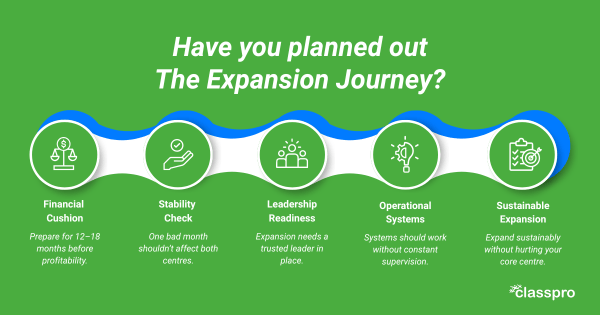
Question 4: Who will run that branch, and do they exist right now?
You can find a location. You can design the interiors and print the brochures. But you can’t rush finding the right person to run the branch.
Yet most owners leave this until the last minute. “We’ll hire someone when the time comes.” That someone will carry your name and your reputation in a new area. They deserve more thought than an afterthought. So name that person before you open a second branch.
The institutes we’ve seen expand well share one thing. A proven person already sat on the team. They had taken on more responsibility over time and handled tough situations. Parents and students trusted them. So the expansion was partly built around that person being ready.
What to ask yourself:
- Is there someone on my team who could run a branch independently?
- Have I been growing that person, with more responsibility and a say in decisions?
- Or am I planning to hire a stranger and hope it works out?
Hiring from outside can work. But an insider already knows your culture, values and ways of working. That’s almost always the safer start.
Question 5: Are you expanding to grow, or to escape something?
This one needs the most honesty. Sometimes the urge to expand has little to do with demand. Maybe Branch 1 feels routine now. Maybe there’s friction you haven’t resolved. Or maybe a competitor opened a second branch, and you felt you should too.
None of these are good reasons. A new branch won’t fix what’s broken at Branch 1. It will copy it. Poor retention shows up at both places, and so does an unhealthy staff culture.
Healthy coaching institute expansion starts from strength. It looks very different from expansion as a distraction. From the inside, though, both feel like forward motion. That’s why this question deserves time.
What to ask yourself:
- Are my results genuinely good, or just good enough?
- Am I excited about reaching more students, or just restless?
- Is there something at Branch 1 I’ve been avoiding?
That last question is worth sitting with for a while. Write your answer down. Then read it again tomorrow.
Registration, GST and paperwork for a new branch
Paperwork is the most overlooked part of coaching institute expansion. Many owners forget that a second branch is a separate centre in the eyes of the law. Several states now require each branch to register on its own. For example, Kohima district in Nagaland asked for a separate application for each branch in February 2026.
Himachal Pradesh went further. Its 2026 rules set a ₹50,000 registration fee, per The News Himachal. Renewal costs ₹25,000, and registration lasts three years. Each branch there needs its own registration. The rules also require one square metre per student and fire safety certificates.
Maharashtra is moving the same way. Its draft 2026 coaching law treats every branch as a separate centre, SCC Online reported. The draft also bans basement premises and requires CCTV with one month of footage. So check your state’s current rules before you open a second branch.
Tax needs attention too. Commercial coaching attracts 18% GST, as a 2026 advance ruling reported by Taxscan confirmed. GST registration also works state by state. So a branch in another state usually needs its own GST number. Confirm the details with your chartered accountant before you open.
How to run two branches without doubling your workload
Two branches mean two sets of fees, attendance, staff and parents. If each branch keeps its own registers, you’ll spend your week chasing updates. So put Branch 1 on one system before you open a second branch.
Start with numbers you can trust. Classpro’s reports show fees, attendance, results and enquiries for each branch on one screen. You can compare branches without waiting for summaries. And your branch head sees the same live data you do.
Next, make daily work consistent across both locations. Biometric attendance records every student the same way at each branch. The student and parent app gives parents one familiar experience, whichever branch their child attends. That consistency protects your name in the new area.
If you’re still on registers and Excel, fix that first. Our guide to coaching institute management software explains what to look for. Moving Branch 1 onto one system gives Branch 2 a ready-made playbook.
So, is it the right time to open a second branch?
There’s no single formula. Anyone who says “open when revenue crosses X” is oversimplifying. But after these five questions, you probably have a feeling already. That feeling is worth listening to.
If you felt quiet confidence, you’re likely closer to ready than you think. The remaining gaps are fixable in a few months. If you felt confusion or anxiety, strengthening Branch 1 is the next step. Our tips to grow your coaching institute are a good place to start.
The institutes that scale well don’t expand the fastest. They expand at the right time, for the right reasons, on a strong foundation. Which of these five questions gave you the most pause? That’s usually the one worth working on first.
When you’re ready, start your free Classpro trial. Set up Branch 1 on one system this month. Or compare Classpro plans and pricing for multi-branch institutes.
FAQs
When is the right time to open a second branch of a coaching institute?
The right time comes when three conditions hold together. Your first branch runs without your daily involvement. You have steady overflow demand across several admission cycles. And you’ve set aside 12 to 18 months of running costs for the new location.
How much money do I need to open a second branch?
Plan for two things: Setup costs and running costs. Setup covers the deposit, interiors, furniture and registration. Running costs cover rent, salaries, utilities and marketing for 12 to 18 months. Add a 20 to 30% buffer on setup, and don’t rely only on Branch 1’s monthly income.
Do I need separate registration for a second coaching branch?
In many states, yes. Nagaland’s Kohima district and Himachal Pradesh treat each branch as a separate centre. Maharashtra’s 2026 draft law proposes the same. A branch in another state usually needs its own GST number too. Confirm this with your chartered accountant.
Who should manage the second branch of my coaching institute?
Ideally, someone already on your team. Look for a person who has handled more responsibility over time and earned parents’ trust. They already understand your culture and values. If that person doesn’t exist yet, developing them is your most important task before expanding.
Who should manage the second branch of my coaching institute?
Ideally, the branch manager should be someone already on your team : a person who has been given increasing responsibility, has earned the trust of parents and students, and understands your institute’s culture and values from the inside. Many successful multi-branch coaching institutes built their expansion plan around an internal person being ready to lead. Hiring a stranger from outside is possible, but carries significantly higher onboarding risk. If that person does not yet exist on your team, developing them is your most important pre-expansion task.
What are the biggest mistakes when opening a second branch?
In our experience, these mistakes cause the most damage:
1. Expanding before Branch 1 can run without the owner.
2. Mistaking one good admission season for lasting demand.
3. Hiring a branch head from outside at the last minute.
4. Underestimating the 12 to 18 months of running costs.
5. Expanding to escape problems that then repeat at the new branch.