
Key takeaways
- Your state decides, not the Centre: Uttar Pradesh covers coaching above three students. Rajasthan starts at 100.
- Four states moved in 2026: Haryana and Madhya Pradesh notified rules. Maharashtra and Chhattisgarh published drafts.
- A trade licence is not coaching institute registration: Most owners need both, plus a fire safety certificate.
- Budget ₹10,000 in Haryana: Renewal costs ₹5,000. The certificate runs for three years.
- Each branch registers on its own: Rajasthan and Madhya Pradesh both count branches separately.
You signed the lease last month. Your boards are up, and the first batch starts in three weeks. Then a parent asks for your registration number. You do not have one, and nobody warned you.
This guide covers coaching institute registration across India. You will see which law applies at your student count. Then you will see the papers, the fees and the timelines. Finally, you will learn what to do when your state has no coaching law.
Coaching institute registration: The short answer
In short: Coaching institute registration means applying to a state body, usually a District Authority. Your student count decides whether the law applies. That trigger runs from three students to 100. The certificate then lasts three to five years. A trade licence, Shops and Establishments registration and GST sit on top of it.
What coaching institute registration actually covers
Owners often ask for the one paper that makes a centre legal. No such paper exists in India. You build your file in layers instead. Each layer comes from a different office, and skipping one does not excuse the rest.
The four layers, and why one never replaces another
- Your entity: Register as a sole proprietor, partnership, LLP or private limited company.
- Your local licence: Apply for a city trade licence and Shops and Establishments registration.
- Your premises: Collect fire and building safety certificates where your state asks for them.
- Your coaching licence: Apply under your state’s coaching Act, if one covers your size.
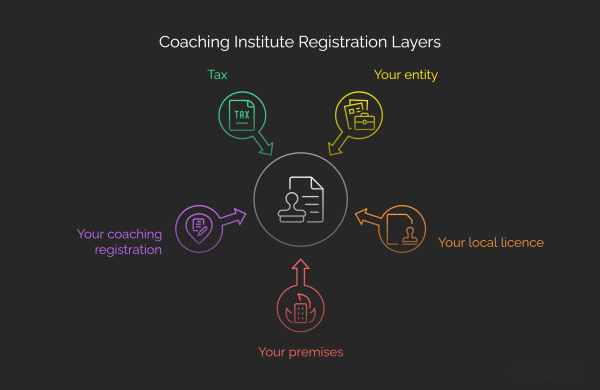
Tax sign-ups run beside all four. You need a PAN, and a TAN once you cut tax on salaries. GST follows once your turnover crosses ₹20 lakh. That limit drops to ₹10 lakh in special category states.
Why “small centres need no licence” is wrong
Plenty of blogs still say small centres need no registration. That advice fails across much of India. Uttar Pradesh has covered coaching above three students since 2002. Goa starts at five students, and Bihar starts at 10.
So a batch of four students in Lucknow already falls under the state Act. Meanwhile, a 90-student centre in Jaipur does not. Your pin code matters as much as your size.
State rules for coaching institute registration in 2027
Education sits on the Concurrent list of the Constitution. So both Parliament and the states may make laws on coaching. The Union Ministry of Education issued model guidelines in January 2024. States then wrote their own rules, and the limits vary widely.
Private coaching is no niche market. PRS Legislative Research cites a 2025 government survey of Indian students. About 75% of secondary and higher secondary students took private coaching. So regulators now look at a very large sector.
States where a coaching law already applies
Coaching institute registration rules by state in 2027
The student count that brings your centre under the state Act.
| State | Law and year | Registration applies above | Penalty |
|---|---|---|---|
| Uttar Pradesh | 2002 | More than 3 students | ₹10,000 to ₹1 lakh |
| Goa | 2001 | More than 5 students | ₹50,000 |
| Bihar | 2010 | More than 10 students | ₹25,000, then ₹1 lakh |
| Manipur | 2017 | More than 20 students | ₹25,000, then ₹1 lakh |
| Haryana | 2024 Act, 2026 Rules | Competitive exam coaching, home tuition up to 50 students excluded | ₹25,000, then ₹1 lakh |
| Rajasthan | 2025 | More than 100 students | ₹50,000, then ₹2 lakh |
- Very low threshold
- Low threshold
- Conditional
- High threshold
Source: PRS Legislative Research, 2025. Many states have no dedicated coaching law, so check with your district education office.
Rajasthan shows where the rules are heading. Its certificate lasts three years. No centre there registers without a counselling system. Tutors must hold a degree, and classes cannot run past five hours a day.
The 2026 notifications you may have missed
Haryana notified its rules on 24 August 2026. Every private centre now applies to its District Authority. The fee is ₹10,000, and the office reviews your file within 30 days. A weak file comes back in writing, and you get 10 days to fix it.
A clean file earns a certificate valid for three years. Renewal then costs ₹5,000. One wording rule catches owners out. You may print “registered coaching institute” on your board, but never “recognised” or “approved”. The Tribune covered the notified Haryana rules in August 2026.
Madhya Pradesh followed in October 2026. Centres already open must apply within 90 days of the gazette notice. Each branch counts as a new centre under those rules. So a three-branch chain files three forms, as Elets digitalLEARNING reported in October 2026.
States with a draft law on the way
Maharashtra published a draft Bill in August 2026. Registration would become a must, and it would last three years. Centres that break the rules face closure, as India TV reported. Suspension and cancelled registration also sit in the draft.
Chhattisgarh moved next, in November 2026. Its draft sets the trigger at 20 students. The certificate would last five years, and fines would run from ₹10,000 to ₹5 lakh. EducationWorld reported the draft on 10 November 2026.
Neither draft is law yet. Still, both copy the pattern set by Haryana and Rajasthan. So plan for registration, not against it.
What to do when your state has no coaching law
Many states still have no coaching law of their own. Tamil Nadu is one example. That gap does not leave you free, because the other three layers still apply.
Do three things instead. First, write to your district education office and ask which approval covers coaching. Second, keep the written reply in your file. Third, finish the trade licence, Shops and Establishments registration and fire certificate anyway.
In our experience, a written reply settles most inspection fights later. A phone call never does. Save the email, and note the date you sent it.
Documents you need for coaching institute registration
Haryana’s notified rules give the clearest published list. Other states ask for much the same papers. Owners who look up how to register a coaching institute often miss half of them. Collect all of these before you apply:
- Course details: Every course you teach, with the length of each one.
- Classroom data: The number of rooms, the seats in each, and your total coaching area.
- Prospectus: One printed copy that covers all your courses.
- Fee schedule: Every fee you charge, plus your refund policy in writing.
- Batch sizes: The highest number of students you allow per batch.
- Staff records: Degrees and bio-data for teaching and non-teaching staff.
- Safety details: Fire measures, separate toilets, drinking water, lighting and first aid.
- Police checks: Proof of whether you verified your staff.
- Premises proof: Your ownership papers or your rent agreement.
- Affidavit: A statement that you run no classes during school hours.
Scan each paper clearly before you upload it. Blurred scans cause most of the 10-day notices. Name every file properly too, so the clerk can match it fast.
The coaching institute registration process, step by step
1. Fix your legal structure first
Most owners start as a sole proprietor, because it costs the least. Move to an LLP or a private limited company when a partner joins. Open a current account in the business name either way. Your form asks for entity proof, so settle this early.
2. Confirm your state limit before the lease
Check the table above, then confirm it locally. Limits change, and two states changed theirs in 2026. Call your district education office and ask one question. Does my student count bring me under the state coaching Act?
3. Clear fire and building safety
Fire and building safety papers take the longest to arrive. Several states make them a condition of registration. So start this file before the fit-out, not after it. Also check that the building’s approved use allows a coaching centre.
4. Apply to the District Authority
Send the papers listed above, with the fee. Haryana reviews within 30 days, and other states publish their own timelines. Keep a copy of the receipt they give you. Then chase the file every week, because silence rarely means progress.
5. Add GST and tax sign-ups
Your classes get no education exemption under GST. They lead to no degree that the law recognises. So register once turnover crosses ₹20 lakh, then charge 18% under SAC 999293. Price with that rate in mind from your first batch. Our guide on fee structure for hybrid coaching classes shows how to build tax into your plans.
Coaching institute registration fees and real costs in 2027
Only notified rules publish a fee. Haryana charges ₹10,000 to register and ₹5,000 to renew. Other states set their own numbers in their own rules. So treat any figure you read elsewhere as a starting point.
The bigger cost sits in the conditions, not the fee. Rajasthan wants one square metre per student in each batch. It also wants CCTV, separate toilets, drinking water and a counsellor. A 40-student batch therefore needs 40 square metres of classroom alone.
Work out those costs before you sign a lease. Owners who budget only for rent and the fee get a shock in month two. Add the fire work, the cameras and the furniture to your first-year plan.
Renewals, branches and cancelled registrations
Coaching institute registration is not a one-time job. Haryana’s certificate runs three years, and you apply to renew one month before it ends. Chhattisgarh’s draft proposes a five-year cycle. Put the expiry date in your calendar the day the certificate arrives.
Branches need their own files. Rajasthan treats each branch as a new centre. Madhya Pradesh does the same thing. So budget one form, one fee and one visit per location.
Fines rise fast with each breach. Rajasthan charges ₹50,000 first, then ₹2 lakh. A further breach cancels the registration outright. Haryana, Bihar and Manipur follow the same rising pattern.
5 mistakes owners make with coaching institute registration
- Signing the lease first: Check the limit and the building’s approved use before you commit.
- Treating a trade licence as enough: It covers the city office, not the education department.
- Forgetting the branches: Two locations usually mean two forms and two fees.
- Missing the renewal: A lapsed certificate counts as running with no registration.
- Keeping records in a notebook: Inspectors want enrolment, fees and tutor data in one place.
That last mistake costs the most time. Haryana now asks registered centres to keep records and publish key details. The list covers enrolment, courses, fees, refunds, tutor degrees and timetables. Your board and your website must both carry the fee structure.
Keep your compliance records ready all year
Registration is paperwork once. Staying registered is paperwork every year. Your district office may ask for batch-wise enrolment, fee records and tutor details at any time. A notebook will not survive that request.
Classpro has supported Indian coaching institutes since 2011. Our fee management module stores every receipt, instalment and refund. Biometric attendance keeps batch records clean. Meanwhile, the reports dashboard pulls enrolment data into one view.
The same system covers the rest of your file. Student performance tracking holds the results data Haryana now asks about. Your enquiries and lead management list shows how each student joined. The parent app then keeps families updated without extra calls.
New to all this? Read what coaching institute management software does first. It explains how the pieces fit together. Then set up the records your state asks for.
Start your free Classpro trial and set your records up properly this week. You can also compare plans and pricing first. Opening your first centre? Read our guide on how to start a coaching centre next.
Already registered? Our post on coaching institute branding covers what to put on that new board. Haryana allows the word “registered” there. It bars “recognised” and “approved”.
FAQs
Is coaching institute registration a must in India?
It depends on your state and your student count. Uttar Pradesh covers coaching above three students, and Rajasthan above 100. Many states have no coaching law at all. Even then, you still need a trade licence and local clearances.
What are the coaching institute registration fees in 2027?
Haryana charges ₹10,000 to register and ₹5,000 to renew. Other states set their own fees in their rules. Add the cost of the fire certificate and the trade licence. Then add the setup the rules demand.
How long does it take to register a coaching institute?
Haryana reviews a clean file within 30 days. A weak file comes back, with 10 days to fix it. Fire and building papers usually take longer. Plan for two to three months in total.
Can I run a coaching class from home with no licence?
Sometimes, and it turns on the state limit. Haryana leaves out home tuition up to 50 students. Uttar Pradesh covers you above three students. Check your society bye-laws and city building rules too.
Do I need GST for my coaching institute?
Yes, once your turnover crosses ₹20 lakh. The limit is ₹10 lakh in special category states. Coaching pays 18% GST under SAC 999293. The education exemption covers schools and degrees, not private coaching.
What happens if I run a centre with no coaching institute licence?
Fines rise with each breach. Rajasthan charges ₹50,000, then ₹2 lakh, then cancels the registration. Haryana, Bihar and Manipur start at ₹25,000 and rise to ₹1 lakh. Your fees and refund policy may come under review too.
Does each branch need its own coaching institute registration?
Yes, in Rajasthan and Madhya Pradesh. Both treat every branch as a new centre. So each location files its own form and pays its own fee. Check your state rules before you open a second branch.