


It is the 10th of the month, and half your JEE batch still has not paid. You have already sent two WhatsApp reminders. Meanwhile, rent, salaries and the electricity bill all fall due this week. Good fee collection fixes this, and it rarely needs harsh words.
This guide gives you six practical tips that coaching owners use to get paid on time. You also get a fee structure format, a fees notice for students and a reminder schedule. Then we cover UPI, the new UPI merchant charges and common mistakes that slow payments.
Fee collection for coaching classes: The quick answer
The best fee collection systems make paying easy and forgetting hard. So set clear dates at admission, then remind parents before each due date. Also give them simple ways to pay, like a UPI link. Finally, keep one clean record, so nobody chases a fee that already came in.
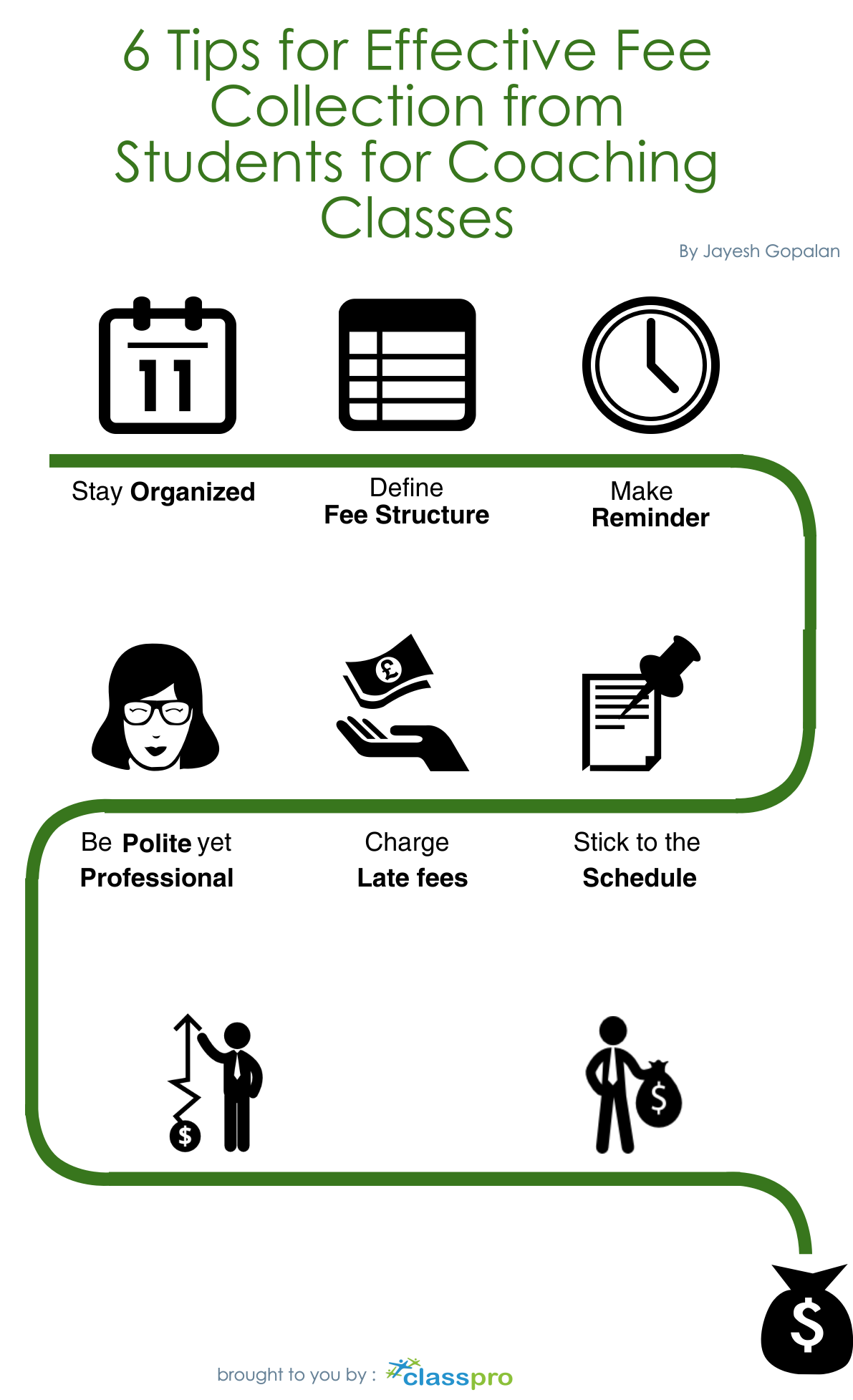
Here are the six tips in short:
- Stay organised: One record for fees, dues and receipts stops staff from chasing paid fees.
- Define your fee structure: Written dates and amounts at admission remove most confusion later.
- Send reminders early: A message before the due date works better than a call after it.
- Stick to a schedule: Follow-ups on fixed days never feel random or personal.
- Set a fair late fee: A clear rule adds urgency without any arguments.
- Stay polite and professional: Happy parents pay on time and refer other families.
Why fees get delayed in coaching classes
Coaching is now a normal part of school life in India. A 2025 MoSPI survey found about 75% of secondary and higher secondary students take private coaching. PRS Legislative Research cites this figure in its 2025 brief on coaching rules. So demand is rarely the problem. In our experience, fees slip for much simpler reasons.
The usual reasons look like this:
- Parents simply forget: Most late payments are memory problems, not money problems.
- Vague dates confuse families: “Pay next week” means a different day to every parent.
- Paying takes effort: A parent who must visit your office in person will put it off.
- Messy records hide dues: Cash, UPI and cheques in different places lead to missed follow-ups.
6 tips for effective fee collection from students
These six tips come from the 2014 version of this post. We kept the same order and updated each tip for how parents pay today. Each tip helps on its own. However, together they work as one simple system.
1. Stay organised with one fee record
Fee problems usually start with scattered records. One teacher notes cash in a register, while UPI payments land on the owner’s phone. Then someone asks a parent for money they already paid. That one awkward call can cost you more trust than a late fee ever earns.
A free tool like Google Sheets works for a small batch. Create one row per student with the total fee, due dates, amounts paid and balance. However, sheets break down once you run several batches or share the file with staff. At that point, a system built for coaching centres saves you hours every month.
Classpro’s fee management feature tracks every instalment, due date and receipt in one place. You can also pull fee reports to see total dues by batch on one screen. As a result, you stop guessing who owes what. Our guide on what coaching institute management software does explains the rest of the toolkit.
2. Clearly define your fee structure
Parents pay on time when they know exactly what to pay and when. So put the full fee structure in writing at admission, before the first class. Collect the lump sum or the first instalment at that moment, too. In our experience, a small discount for full upfront payment works well.
Instalments help families manage large fees, and some states now expect them. For example, Rajasthan’s Coaching Centres Bill, 2025 proposes an option to pay in at least four instalments. It also bars fee increases in the middle of a course. So check your state’s coaching rules before you finalise your plan.
Here is a simple fee structure format for coaching classes that you can adapt:
| Item | Example |
|---|---|
| Course | JEE Main, one-year batch |
| Total fee | ₹60,000 Plus GST if you are registered |
| Option A | Full payment at admission 5% discount |
| Option B | Four instalments of ₹15,000 each |
| Due dates |
|
| Payment modes |
|
| Late fee rule | ₹100 per week after a five-day grace period |
| Refund policy | Pro-rata refund if the student leaves mid-course |
Some centres still collect post-dated cheques at admission. They work, but a bounced cheque leads to a slow and awkward recovery. UPI AutoPay now does the same job with far less paperwork.
3. Send fee reminders before the due date
Most parents do not skip fees on purpose. They forget, because they juggle school fees, tuition and household bills every month. So a short reminder a few days early prevents most late payments. A friendly phone call also builds a personal bond with parents.
In our experience, this three-touch schedule works well:
- 3 days before: A friendly WhatsApp or SMS with the amount, due date and payment link.
- On the due date: A short note that today is the last day, with the same link.
- 3 days after: A polite follow-up, then a phone call if you still get no reply.
Here is a sample fees notice for students that your staff can copy:
Dear Parent, this is a gentle reminder about Aarav’s JEE fees. The second instalment of ₹15,000 is due on 5 July. You can pay by UPI using this link: [payment link]. Please ignore this message if you have already paid. Thank you, [Institute name].
Classpro’s notifications and reminders feature sends these messages automatically before each due date. Parents can also check dues and receipts in the student and parent app. For more message ideas, see our WhatsApp message templates for coaching institutes.
4. Stick to the schedule
Random follow-ups make an institute look disorganised. Chasing one parent daily and another never also feels unfair. So follow the same schedule for every student, every month. Then parents learn your rhythm and pay before the calls begin.
Also, give one person clear ownership of fee follow-ups. When three staff members call the same parent, it annoys the family. When nobody calls, dues pile up quietly. A weekly look at your dues list keeps fee collection on track.
5. Set a fair late fee policy
A late fee adds urgency, so your fees do not sink to the bottom of the pile. However, it only works when parents know the rule before they join. So print it on the admission form and on every fee receipt. Mention the amount, the grace period and when it applies.
Keep the rule fair and simple. In our experience, a flat charge after a short grace period works better than monthly interest. For example, you might charge ₹100 per week after a five-day grace period. Parents understand a flat amount instantly, and your staff can apply it without a calculator.
6. Be polite, yet professional
Your tone decides whether a parent pays or quietly moves to another centre. So use “please” and “thank you” in every message. Never discuss a student’s dues in front of the batch. And do not let one late payment colour how you treat the family later.
Sometimes a parent explains a real money problem, like a job loss. In that case, offer a revised plan with smaller instalments. You still get paid, and the family remembers your kindness. In our experience, those parents often become your strongest source of referrals and new admissions.
How to accept coaching fees online: UPI, links and cash
Parents now pay for almost everything by UPI. NPCI data reported by Business Standard shows 24.51 billion UPI transactions in August 2026 alone. That figure grew 22% over August 2025. So a centre that takes only cash or cheques makes paying harder than it needs to be.
Here is how the common payment options compare:
| Method | Best for | Watch out for |
|---|---|---|
|
UPI QR code
|
Walk-in payments at the front desk | Match each payment to the right student |
|
UPI payment link
|
Reminders on WhatsApp or SMS | Add the student’s name and amount to each link |
|
UPI AutoPay
|
Monthly fees | Parents approve the mandate once at the start |
|
Bank transfer
|
Large lump-sum fees | Ask for a reference number to match it quickly |
|
Cash
|
Parents who prefer it | Issue a numbered receipt on the same day |
One change needs your attention this October. From 15 October 2026, a 0.4% merchant charge applies to many UPI payments above ₹2,000. The Ministry of Finance FAQ caps it at ₹300 per transaction. Small merchants who receive up to ₹1 lakh a month through QR codes stay exempt.
The same FAQ places school and college fees in a special category with flat or capped rates. Coaching centres should confirm whether their account qualifies. The FAQ also says UPI AutoPay mandates carry no prescribed charge. However, you cannot pass the charge on to parents. So check your merchant category with your bank or payment gateway before 15 October.
Fee collection mistakes to avoid
Watch out for these common fee collection slip-ups:
- Skipping receipts invites disputes: Every payment, even cash, needs a numbered receipt on the same day.
- Vague dates cause late payments: “Early next month” means nothing, so always give an exact date.
- Late reminders arrive too late: After the due date, parents may have spent the money elsewhere.
- Public reminders embarrass students: Never read out the names of late payers in class.
- Mid-course fee hikes break trust: Some states now bar them, and parents remember them for years.
- Mixed accounts blur your books: Keep centre payments apart from personal UPI to simplify GST and audits.
How Classpro supports fee collection
Classpro is a coaching management platform with a built-in fee collection app. It links fees to enquiries and admissions, so you set the first instalment from day one. It also sits alongside biometric attendance, so you see attendance and dues together for each student. Owners can check pending fees from their phone at any time.
Fee records hold sensitive parent data, so security matters too. Our post on why institutes trust Classpro with their data explains the role-based access controls. If you are comparing tools, read our guide to the best coaching institute management software.
Final thoughts
Good fee collection comes down to a few steady habits. Clear dates, early reminders and easy UPI payments solve most delays. A fair late fee and a polite tone handle the rest. So start with one change this month, like the three-touch reminder schedule.
Want to automate the whole process? Start your free Classpro trial and try automated fee reminders with your own batches. You can also compare Classpro plans and pricing first.
FAQs
How do I improve fee collection in my coaching class?
Share a written fee structure at admission with exact due dates. Then send reminders three days before each date and again on the day. Also accept UPI payments through a link or QR code. Finally, track every payment in one record, so nothing slips through.
What is a good fee structure format for coaching classes?
A good format lists the course, total fee, payment options, due dates and payment modes. It should also state your late fee rule and refund policy. Keep it to one page, and give parents a copy at admission. You can adapt the sample table in tip 2 above.
How do I write a fees notice for students?
Keep it short and friendly. Include the student’s name, the amount, the due date and a payment link. Add a line asking parents to ignore it if they have already paid. Send it by WhatsApp or SMS about three days before the due date.
What should a fee receipt for coaching classes include?
A receipt should show your centre’s name, a receipt number, the date and the student’s name. It should also list the amount, the payment mode and the balance due. If you have GST registration, add your GSTIN and the tax breakup. Private coaching usually attracts 18% GST, so confirm your rules with a CA.
Can students get a refund of coaching fees?
Yes, in many cases. For example, Rajasthan’s 2025 coaching bill proposes pro-rata refunds for the course, hostel and mess. So publish a clear refund policy and share it at admission. Rules differ by state, so check yours with a local expert.
Is there a free fee collection app for coaching classes?
Some apps offer free plans with limited features. Classpro offers a free trial, so you can test reminders, online payments and receipts first. After that, you can pick a plan that fits your batch size. Also, check how any app handles receipts and data security before you commit.



5 Comments
A wonderful initiative by Jayesh to write this educative and thought instigating article. It clearly voices out the concerns that coaching institute owners like me experience in the day to day running of our institute. When i read the first draft,I could so well connect to it. I would encourage everyone to read this article and give their valuable perspectives whichnwill help Jayen write more such wonderful articles .
Thank you so much jayesh Sir for very wonderful procedure.
Thank you so much sir
Good one.
In order to find out the best approaches to do well in academic approaches in progressive thoughts each step is making the momentum fortune in every single manner. this is the ideal association in taking the best thoughts in coming the process flows promising.