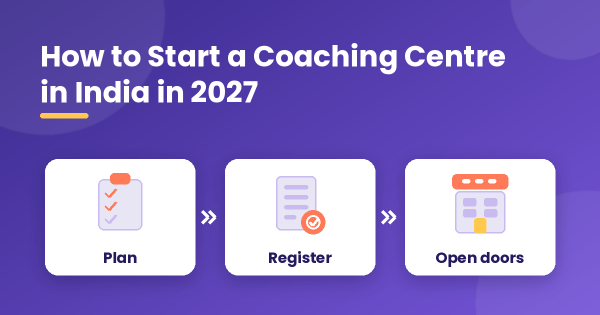

Key takeaways
- Check your state’s coaching law before you sign a lease. Uttar Pradesh regulates coaching above three students. Rajasthan starts at 100.
- Budget for the registration conditions, not just the rent. Fire certificates, floor space per student and CCTV all cost money.
- Coaching fees carry 18% GST once you cross ₹20 lakh. Your centre is not an exempt educational institution under GST law.
- Hire graduates. Several state laws now set that as the minimum tutor qualification.
- Work out your break-even in students, not rupees. That one number tells you whether year one works.
You have taught for years. Parents already ask whether you take private batches. So you start looking at shops near the school gate, and the rent sounds manageable. Then someone mentions registration, GST and a fire certificate, and the plan stalls.
This guide covers how to start a coaching centre in 10 steps. You will see which law applies at your size. Then you will see what the paperwork really demands. Finally, you will learn how to fill your first batch.
How to start a coaching centre: The short answer
To start a coaching centre, pick one exam or class group first. Then check your state’s coaching law before you sign a lease. Register the business and collect your trade licence. Fit the space to the floor-space rule, price the course, and open with one full batch.
The steps run the same however you phrase the question. Some people ask how to start a coaching institute. Others ask how to open a coaching centre. Only the thresholds change with your student numbers.
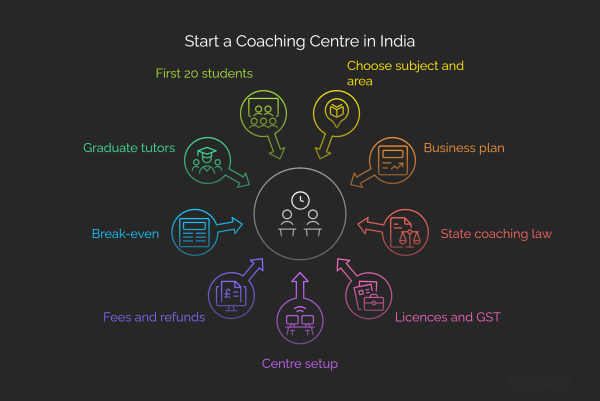
Steps 1 to 3: Decide what you teach and where
1. Pick one exam or one class group
New owners want to teach everything. That choice kills them in year one. Pick one thing instead: Class 10 maths, NEET biology, or SSC quantitative aptitude.
One subject means one timetable, one set of notes and one clear promise to parents. You can add a second batch after your first results come out. So resist the pressure to look big on day one.
Demand is real, so you do not need to spread yourself thin. IMARC Group puts India’s coaching institutes market at USD 8.1 billion in 2026. That is up from USD 7.2 billion in 2025.
2. Check demand within 3 km
Walk the area before you commit. Count the schools, note their boards, and check which classes finish by 3 pm. Those timings decide your batch slots.
Then ask 15 parents two questions. What does your child struggle with? What do you pay now? In our experience, 15 honest answers beat any market report.
Also look at who already teaches there. If four centres run NEET batches on the same street, teach Class 9 and 10 instead. Owners asking how to open a coaching centre often skip this walk, then wonder why admissions stall.
3. Write a one-page coaching centre business plan
Most owners start as a sole proprietor. It costs the least and takes the least time. Move to a partnership or private limited company later. Do that once you take on a co-founder or outside money.
Then write your coaching centre business plan on a single page. List your subject, your batch size, your monthly fee, your fixed costs and your break-even. Anything longer than a page usually hides a guess.
Open a current account in the business name either way. Mixing personal and centre money makes your first tax filing painful. It also hides whether the centre actually earns anything.
Steps 4 to 5: Coaching centre registration and licences
4. Check your state’s coaching centre registration rules
Here is the step almost every guide gets wrong. Plenty of blogs say small centres need no registration. That advice is wrong across most of India.
Education sits on the Concurrent list, so states write their own coaching laws. The thresholds then vary wildly. PRS Legislative Research compared them in its 2025 brief on the Rajasthan coaching Bill.
Coaching centre registration thresholds by state
The student count that brings your centre under the state Act.
| State | Law | Registration applies above |
|---|---|---|
| Uttar Pradesh | 2002 | More than 3 students |
| Goa | 2001 | More than 5 students |
| Bihar | 2010 | More than 10 students |
| Manipur | 2017 | More than 20 students |
| Haryana | 2024 | Competitive exam coaching, home tuition up to 50 students excluded |
| Rajasthan | 2025 | More than 100 students |
Very low threshold Low threshold Conditional High threshold
Source: PRS Legislative Research, 2025. Many states have no dedicated coaching law, so check with your district education office.
Read that table again. A four-student batch in Lucknow already falls under the state Act. A 90-student centre in Jaipur does not. So your coaching centre registration duty depends on your pin code as much as your size.
Rajasthan shows where this is heading. Registration there runs three years, and each branch registers separately. A first violation attracts ₹50,000, a second attracts ₹2 lakh, and further violations cancel the registration.
Many states still have no dedicated coaching law. Tamil Nadu is one of them. So call your district education office before you plan around any table, including this one.
5. Line up licences and GST in order
Finish your coaching centre registration before the fit-out starts. Work through these in sequence, because each one usually needs the previous one:
- Shops and Establishments registration: File with your local authority once you hire staff.
- Trade licence: Apply to your municipal body. Some cities check building use first.
- Fire and building safety certificate: Several state coaching laws make this a registration condition.
- PAN and TAN: You need TAN to deduct tax on salaries.
- GST registration: Register once turnover crosses ₹20 lakh, or ₹10 lakh in special category states.
One GST point surprises new owners every year. Coaching gets no education exemption. The GST Council’s own guide on education services rules private coaching out. The training leads to no legally recognised qualification.
So your fees attract 18% GST under SAC 999293 once you register. Price with that in mind from day one. Owners who add 18% to fees in year two lose students.
Steps 6 to 8: Set up the centre and the money
6. Find a space that passes inspection
Rent decides your break-even. The registration conditions decide whether you open at all. So read both before you sign anything.
Rajasthan’s 2025 law lists what inspectors look for. Expect similar conditions wherever your state regulates coaching:
- One square metre per student in each batch.
- Fire and building safety certificate for the premises.
- CCTV cameras across the centre.
- Separate toilets for male and female students.
- Drinking water, first aid and ventilation that actually work.
Do the maths before you sign. A 40-student batch needs 40 square metres of classroom alone. Add the office and the corridor on top of that.
Also check the building’s approved use. A residential flat rarely clears a municipal inspection for a coaching centre. Owners asking how to open a coaching centre at home run into this first.
7. Set fees, instalments and refunds
Price against what families already spend, not against the centre down the road. The government’s Comprehensive Modular Survey: Education, 2025 measured exactly that. Annual coaching spend per student reached ₹3,988 in urban India and ₹1,793 in rural India.
Then write three things down before you take a single rupee:
- The instalment plan. Rajasthan’s law requires at least four instalments.
- The refund rule. Rajasthan requires pro-rata refunds when a student leaves.
- The no-hike promise. You cannot raise fees during a running course there.
Publish all three even outside a regulated state. Parents compare refund policies more than they compare faculty. Our fee management module handles instalment plans and receipts, so nobody argues about what was paid.
8. Work out your break-even
Most owners track revenue. Track students instead. One number is easier to manage than a spreadsheet.
Add your fixed monthly costs: Rent, salaries, electricity, internet and software. Say that comes to ₹80,000. Say you charge ₹2,000 a month per student. Your break-even is 40 students.
Put that number at the top of your coaching centre business plan. A second teacher at ₹20,000 moves break-even to 50 students. So you need 10 more admissions before that hire makes sense.
Check the number monthly, not yearly. Our reports dashboard shows collections and dues in one view. That way you see the gap early enough to fix it.
Steps 9 to 10: Hire and fill your first batch
9. Hire tutors who meet the graduate rule
Several state laws now set a floor. Rajasthan’s 2025 Act bars tutors below graduate level. Other states are moving the same way.
That law also caps teaching at five hours a day. It requires a weekly off for students and tutors too. So build your timetable around those limits now, rather than rewriting it later.
Pay matters less than you think in year one. Predictable hours and a clear role matter more. Our guide on reducing teacher turnover covers what keeps good faculty.
One more rule catches people out. Regular cadre teachers in government institutions cannot teach at coaching centres in Rajasthan. So check your state before you hire from a nearby school.
10. Get your first 20 students
Parents search before they visit. So claim your Google Business Profile in week one. Add photos, timings and your phone number, then ask early parents for reviews. Our post on Google SEO and Google Ads for coaching institutes walks through the setup.
Next, build a simple site with your courses, timings and one enquiry button. You can do this free, as our list of website builders for coaching classes shows. Keep the enquiry button above the fold.
Then run two free demo classes. Invite parents to sit in for the last 10 minutes. That one habit converts better than any pamphlet.
Finally, call every enquiry back within 30 minutes. Leads go cold fast, and most centres lose admissions between the enquiry and the follow-up. Our enquiries and lead management tool keeps every lead and its history in one list.
Your first 90 days, week by week
Keep the order. The licence work has to finish before the rent starts.
| Period | What you do |
|---|---|
| 1Weeks 1 to 2 |
|
| 2Weeks 3 to 4 |
|
| 3Weeks 5 to 6 |
|
| 4Weeks 7 to 8 |
|
| 5Weeks 9 to 10 |
|
| 6Weeks 11 to 12 |
|
Owners who sign a lease in week one usually find a licence problem in week six. By then the rent has already started.
5 mistakes new coaching centre owners make
Most owners asking how to open a coaching centre make at least two of these.
- Signing a lease before checking the law. Fix the registration threshold first, then the premises.
- Teaching five subjects in month one. One batch done well fills the next three.
- Ignoring GST until the notice arrives. Build 18% into your pricing before you cross the threshold.
- Running fees on a notebook. Dues go missing, and parents remember the awkward reminder call.
- Skipping parent updates. Silence between results is why students leave at term end.
That last one costs the most. Send attendance and marks updates every week through a parent app. Renewals then get much easier, because parents already know how their child is doing.
Run your centre on one system from day one
Knowing how to start a coaching centre is one job. Running it on day 40 is another. Your first 40 students fit in a notebook, but your next 100 will not. Attendance, fees, test marks and parent messages all grow together.
Classpro has supported Indian coaching institutes since 2011. Biometric attendance and student performance tracking run on one dashboard with fees and parent updates. So your teachers spend their time teaching.
Start your free Classpro trial and set up your first batch today. You can also compare plans and pricing before you decide. Then review your admissions after four weeks.
FAQs
How to start a coaching centre with no money?
Start at home or in a rented hall for two hours a day. Teach one subject, charge monthly, and use free tools for your website and notes. Our list of free online tools for coaching classes covers the basics. Move to a leased space once one batch fills.
How to open a coaching centre legally in India?
Start with your state’s coaching law, because the student threshold decides everything else. Then add Shops and Establishments registration, a municipal trade licence and a fire certificate. Register for GST once turnover crosses ₹20 lakh. Many small centres also need coaching centre registration, so check locally first.
Is GST applicable on coaching centre fees?
Yes, at 18% under SAC 999293, once your turnover crosses ₹20 lakh. The threshold drops to ₹10 lakh in special category states. Coaching gets no education exemption, because it leads to no legally recognised qualification.
How many students do I need to break even?
Divide your fixed monthly costs by your monthly fee per student. A centre with ₹80,000 of costs charging ₹2,000 a month breaks even at 40 students. Recalculate every time you add a teacher or raise the rent.
What qualification do coaching centre teachers need?
Rajasthan’s 2025 law requires tutors to hold at least a graduate degree. Several other states are moving the same way. Check your state rules before you hire, especially if you plan to hire a government school teacher.
Should I start online or offline coaching?
Offline still wins for school tuition, because parents want supervision. Online suits competitive exam coaching and lets you teach beyond your city. Most owners asking how to start a coaching institute begin offline, then record classes for revision.
How long does it take to open a coaching centre?
Plan for 90 days from decision to first class. Registration and the fire certificate take the longest. You can move faster where no dedicated coaching law applies. Even then, do not skip the municipal trade licence.