
A parent in your city opens Google right now and types “best NEET coaching near me.” Three results appear. They call the first one. If your institute isn’t in those three — you don’t exist for them. That’s not an exaggeration. That’s the admission journey in 2026, and the same thing is happening thousands of times a day across every city in India.
At Classpro, we have worked closely with offline coaching institutes across the country — from small institutes to multi-branch institutions with thousands of students. The pattern we keep seeing is the same: institutes that invest in Google SEO and Google Ads consistently fill their batches faster, reduce dependence on costly tradional marketing, and build compounding visibility year over year. Those that don’t, watch competitors take the enquiries that should have been theirs.
This guide shares what we know works — drawn from real institute data, admission trends, and the digital strategies that have shown proven results.
SEO vs Google Ads — two tools, one goal
Before spending a single rupee, understand the difference between these two channels — because they do different jobs.
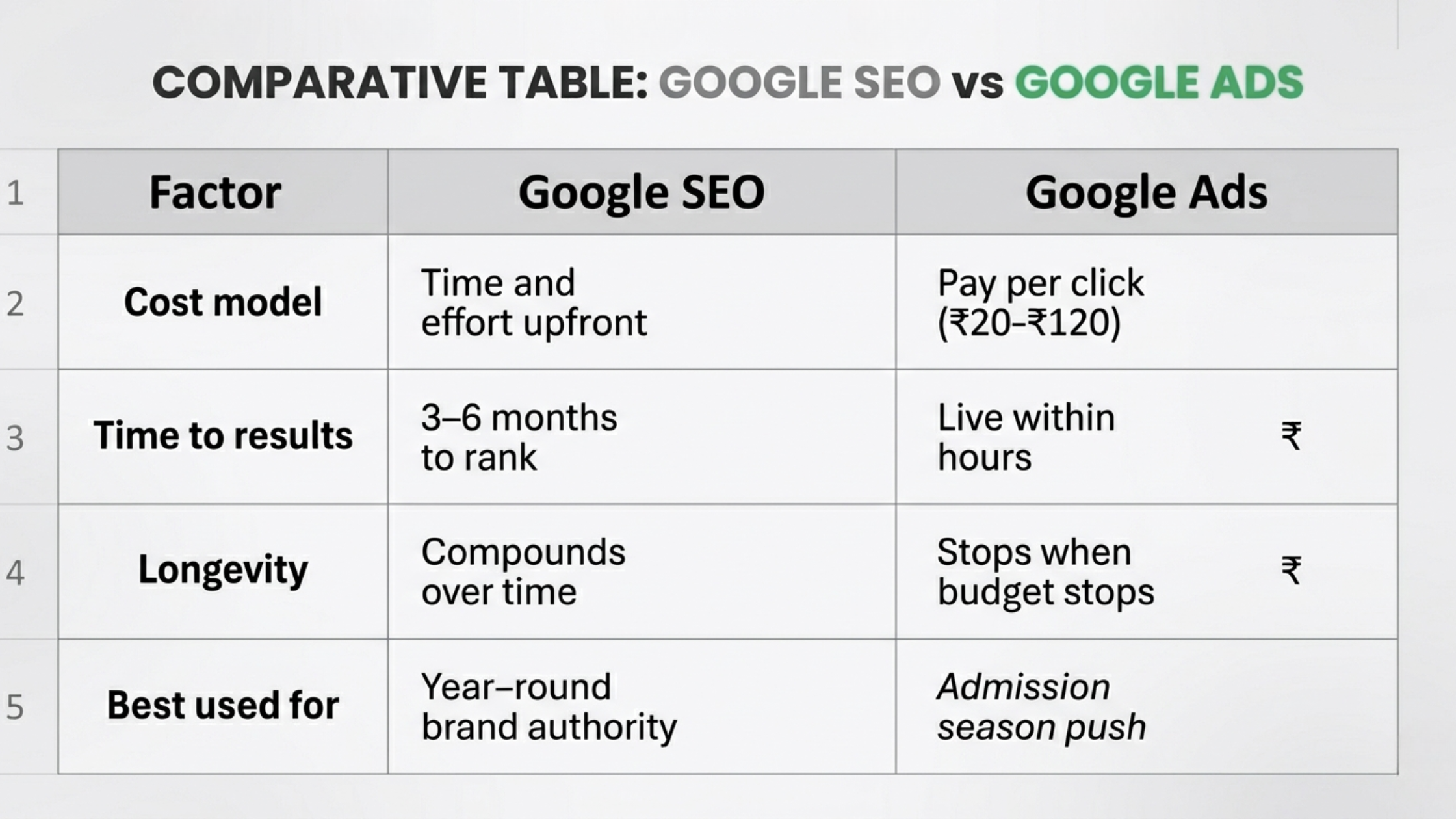
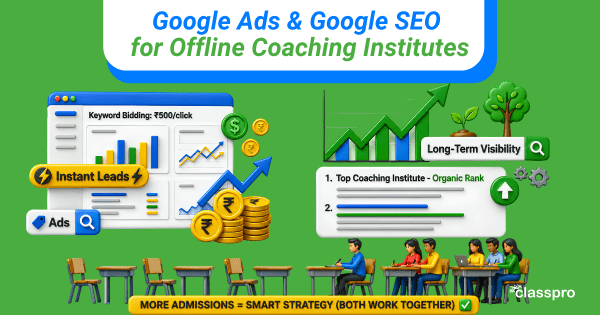
The institutes that grow the fastest don’t choose between the two. In fact, they use both. SEO builds the foundation so your institute shows up organically every day. Ads give you an immediate boost when it counts — result season, new batch announcements, free demo class promotions, and mostly admission season. Together, they cover the full admission funnel from first discovery to enquiry call.
Google SEO strategies for coaching institutes
Claim and fully optimise your Google Business Profile
Your Google Business Profile (GBP) is the most powerful, zero-cost SEO asset available to any coaching institute. When someone searches “JEE coaching near me,” Google surfaces three local businesses in a map pack at the very top of results. Getting into that pack starts with a fully built-out GBP.
What you must do: verify your listing, add your precise address and phone number, upload at least 10 clear photos of your classrooms, faculty, and results boards, write a keyword-rich description that mentions your courses and your city, and post weekly updates — new batch dates, student achievements, demo class offers. Institutes that post consistently to GBP rank higher in local search than those that set it up once and forget it.
Target local and exam-specific keywords
Generic terms like “coaching institute” are dominated by large aggregator sites. What actually drives enquiries is combining the exam or subject with your specific city and locality. Strong examples: “NEET coaching in Bhopal,” “Class 10 maths tuition Arera Colony,” “UPSC coaching Indore with fee structure.” Use Google Keyword Planner or Ubersuggest to discover what parents in your area actually type. Then build separate, dedicated pages on your website for each major course — one for NEET, one for JEE, one for Foundation — each page built around its own keyword cluster.
Build SEO-ready course pages
Every course page on your website needs: the target keyword in the page title and the first heading, a clear description of batch schedules, faculty credentials, and fee range, a visible enquiry form or WhatsApp button above the scroll point, and student testimonials or result screenshots. Page speed is equally critical — over 70% of education searches in India happen on mobile. If your site takes more than 3 seconds to load, most visitors leave before reading a single line.
Build local authority through reviews and backlinks
Ask every enrolled student or parent for a Google review, ideally right after results or a standout demo class. Respond to every review within 24 hours — positive and critical. Google reads active review management as a trust signal and rewards it with higher local rankings. Also list your institute on Justdial, Sulekha, college dunia, Shiksha, and local education directories. These backlinks are free and signal credibility to Google’s algorithm over time.
Google Ads strategies for coaching institutes
Use Search Ads and NOT display for enquiries
For coaching institutes, Google Search Ads consistently outperform Display Ads. Search Ads appear at the top of results when a parent actively types “JEE coaching Viman Nagar, Pune” — the intent is already there. Display Ads appear as banners on third-party websites and interrupt people who aren’t looking. Always start your budget with Search.
Write ad copy that converts on the first read
Your ad needs to answer one question instantly: “Why should I call this institute?” Avoid vague phrases like “best coaching in the city.” Use specifics and proof: “96 Students Cleared NEET 2025 | Free Demo Class Saturday | Limited Seats.” Every strong coaching ad has three components — a result-based claim, a location or course signal, and a Call to action. Ads with specific outcomes consistently outperform generic ones by 2 to 3 times in click-through rate.
Set a smart budget and precise location targeting
Start with ₹300–₹500 per day and use Google’s “Maximise Conversions” bidding strategy. Restrict your location targeting to a 5–15 km radius around your institute — there is no value in paying for clicks from students who will never travel to you. Focus your spend on peak search windows: 7–10 AM and 6–9 PM, when parents research coaching options before and after school hours.
Retarget visitors who didn’t enquire
Most people who visit your website leave without filling an enquiry form. Retargeting ads follow those specific visitors across Google’s network — YouTube, Gmail, news sites — and remind them of your institute. Because you’re advertising only to people who already showed intent, retargeting campaigns typically deliver 20–35% more conversions at a fraction of the cost of cold traffic campaigns.
Classpro’s fool-proof Google Ads and SEO tips for Institute owners
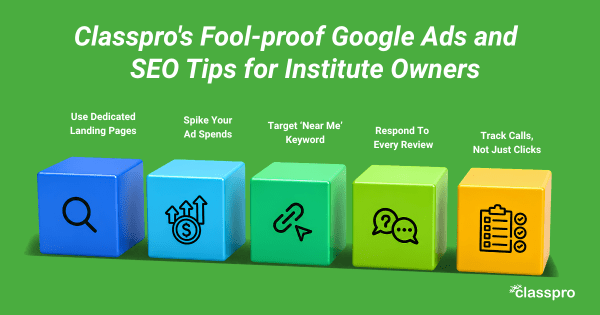
These are the moves we’ve seen make the clearest difference across the coaching institutes we work with.
Use dedicated landing pages, not your homepage. Never send ad traffic to your generic homepage. Build a focused page for each course with one clear call to action — an enquiry form or WhatsApp button. Institutes doing this see significantly fewer dropped leads.
Target “near me” keywords specifically. Add phrases like “coaching near [landmark]” and “tuition near [area name]” to your keyword list. These carry high purchase intent, face low competition, and are extremely local — exactly the kind of query a parent types when they’re ready to decide.
Spike your ad spends during the result season. The 6-week window after board results are declared is when families make coaching decisions. This is when your daily ad budget should peak — not stay flat like the rest of the year. Plan your calendar around this window every year.
Respond to every Google review. Reply within 24 hours to all reviews — positive and critical. Google treats consistent review responses as a trust signal that directly improves your position in the local map pack. It takes two minutes, costs nothing, and makes a measurable difference to your credibility. Track calls, not just clicks. Enable Google Ads call tracking. A click that doesn’t become a call tells you your landing page needs work. A call that doesn’t convert tells you your follow-up process needs work. Measure the full funnel, don’t just skim through it.
Mistakes that silently drain your marketing budget
We see many offline coaching institutes make these 3 most common and expensive mistakes.
Running ads without location targeting. Setting a state-wide or national campaign for a local institute burns the budget on clicks that will never convert into admissions. Always restrict to the radius your students actually travel from.
Sending paid traffic to a slow, non-mobile site. If your website isn’t mobile-optimised and doesn’t load in under 3 seconds, every rupee you spend on Ads is largely wasted. The click happens, the visitor leaves, nothing converts.
Having no fast follow-up system. Research on lead response consistently shows that the probability of converting a new enquiry drops by 80% if the first call-back happens more than an hour after the form is submitted. Getting the lead is half the job. The other half is responding before a competitor does.
Build the system, not just the campaign
Google SEO and Google Ads for offline coaching institutes are not one-time campaigns — they are ongoing systems that compound over time. The institutes growing in 2026 are those that show up consistently in search, respond to every enquiry within minutes, and improve their digital presence month over month rather than trying to do it all overnight, tripping over the execution, and giving up on a system that just needed more time.
Getting found on Google is the beginning. What happens next — how quickly you respond, how smoothly the student moves from enquiry to enrolment, how well you track every lead from first click to fee payment — determines whether your marketing spend becomes growth or just cost.
At Classpro, we don’t just call ourselves a growth partner — we’re built to act like one. Getting found on Google brings the enquiry in. Classpro takes it from there — organizing every lead for timely follow-ups, automating attendance and communication, digitizing fee collection, and streamlining the day-to-day operations that would otherwise slow you down. Because growth isn’t just about being discovered. It’s about being ready when you are.
Classpro — Built for coaching institutes, by people who understand education.
FAQs
How can my offline coaching institute appear on Google when parents search u0022coaching near meu0022?
The fastest way to appear in local Google searches is to u003cstrongu003eclaim and fully optimise your Google Business Profile (GBP)u003c/strongu003e. When parents search u0022NEET coaching near meu0022 or u0022JEE coaching near me,u0022 Google shows a local map pack of three results at the very top — before any other website. Getting into that pack requires a verified GBP with your precise address, phone number, at least 10 photos of classrooms and results boards, a keyword-rich description mentioning your courses and city, and weekly posts about new batches or demo classes.u003cbru003eu003cbru003eBeyond GBP, your website should have dedicated pages for each course — one for NEET, one for JEE, one for Foundation — each built around local keywords like u0022NEET coaching in Bhopalu0022 or u0022Class 10 maths tuition Arera Colony.u0022 Combine these two steps and your institute becomes visible to high-intent parents in your area at no ongoing cost.
What is the difference between Google SEO and Google Ads for a coaching institute, and which should I use?
Google SEO builds your organic visibility over time — it is free to maintain and compounds month over month. Once your institute ranks well, every click costs you nothing. Google Ads puts your institute at the top of search results immediately, but only for as long as you are paying.u003cbru003eu003cbru003eFor offline coaching institutes, the most effective approach is to use both together. SEO builds the foundation so your institute shows up organically every day. Ads give you an immediate boost during critical windows — result season, new batch announcements, free demo class promotions, and admission season. Together they cover the full admission funnel from first discovery to enquiry call. Institutes that rely on only one channel consistently underperform those that use both.
What keywords should an offline coaching institute target for Google SEO in India?
Generic terms like u0022coaching instituteu0022 or u0022best coachingu0022 are dominated by large aggregator sites and are nearly impossible for a local institute to rank for. The keywords that actually drive admissions enquiries are exam or subject combined with city and locality.u003cbru003eu003cbru003eStrong examples include: u0022NEET coaching in [city name],u0022 u0022Class 10 maths tuition [area name],u0022 u0022UPSC coaching [city name] with fee structure,u0022 and u0022JEE offline coaching near [landmark].u0022 Also include u0022near meu0022 variations, as these carry the highest purchase intent among parents who are ready to make a decision. Use free tools like Google Keyword Planner or Ubersuggest to find exactly what parents in your city are typing, then build a separate dedicated page on your website for each major course around those keyword clusters.
How much should an offline coaching institute spend on Google Ads, and how should the budget be set?
A practical starting budget for a local coaching institute is ₹300–₹500 per day, using Google’s u0022Maximise Conversionsu0022 bidding strategy. The most important setting is location targeting — restrict your ads to a 5–15 km radius around your institute. There is no value in paying for clicks from students who will never travel to your campus.u003cbru003eu003cbru003eTiming also matters. Focus your spend on 7–10 AM and 6–9 PM, when parents research coaching options before and after school hours. Most importantly, spike your ad budget during the 6-week window after board results are declared — this is when families actively make coaching decisions, and your daily spend should peak accordingly. Running a flat budget throughout the year means overspending in slow months and underspending in the one window that matters most.
How long does Google SEO take to show results for an offline coaching institute?
This is one of the most searched questions by institute owners who are deciding whether to invest in SEO or go straight to paid ads — and the honest answer is 3 to 6 months for meaningful organic traction, and 6 to 12 months for consistent top-3 local rankings in competitive cities.u003cbru003eu003cbru003eThe timeline depends on three factors: how optimised your Google Business Profile is today, how much local competition exists for your target keywords, and how consistently you publish content and collect reviews. Institutes starting from zero — no GBP, no course pages, no reviews — sit at the longer end. Institutes with an existing website that just needs keyword-focused course pages and active review management often see movement in 8 to 12 weeks.u003cbru003eu003cbru003eThe reason SEO is still worth pursuing despite the wait is compounding returns. A paid ad stops the moment you stop paying. An organic ranking built over 6 months continues delivering enquiries for years at no additional cost. The institutes that grow most efficiently run Ads for immediate results while building SEO in parallel so they become less dependent on ad spend over time.
How should a coaching institute handle negative Google reviews?
Negative reviews feel personal, but how you respond to them publicly matters far more to prospective parents than the review itself. A well-handled negative review actually builds trust — it shows the institute is accountable and takes feedback seriously.u003cbru003eu003cbru003eThe right response framework is simple: acknowledge the concern without being defensive, apologise for the experience, and offer to resolve it offline by sharing a contact number or asking them to reach out directly. Never argue with the reviewer in the comments, never ask Google to delete a review unless it violates clear policy guidelines (fake, spam, or irrelevant content), and never ignore it.u003cbru003eu003cbru003eFrom an SEO perspective, responding to negative reviews within 24 hours signals to Google that your profile is actively managed — this contributes directly to local ranking. From an admissions perspective, parents reading your reviews are also reading your responses. An institute that responds to criticism with professionalism and a genuine offer to help consistently earns more trust than one with a perfect rating and no engagement at all.
How can a coaching institute turn website visitors into admissions enquiries using Google Ads?
Three practices make the biggest difference in converting ad clicks into actual enquiries.u003cbru003eu003cbru003eUse dedicated landing pages, not your homepage. Every ad should link to a focused page built for that specific course — with a single clear call to action such as an enquiry form or WhatsApp button. Sending all traffic to a generic homepage significantly increases dropped leads.u003cbru003eu003cbru003eWrite ad copy with specific proof, not vague claims. Instead of u0022best coaching in the city,u0022 use specifics: u002296 Students Cleared NEET 2025 | Free Demo Class Saturday | Limited Seats.u0022 Ads with result-based claims consistently outperform generic ones by 2–3x in click-through rate.u003cbru003eu003cbru003eRetarget visitors who didn’t enquire. Most people visit a website and leave without filling a form. Retargeting ads follow those specific visitors across YouTube, Gmail, and news sites and remind them of your institute. Because you’re advertising only to people who already showed intent, retargeting campaigns deliver 20–35% more conversions at a fraction of the cost of reaching cold traffic.