

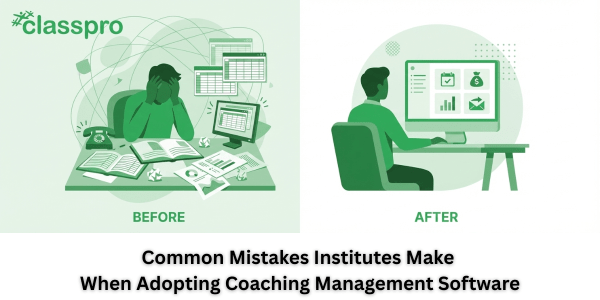

Be honest with yourself for a moment.
Did you adopt coaching management software to actually fix how your institute runs, or did you adopt it hoping the software would fix things for you?
Most coaching institute owners don’t wake up excited about technology. You adopt software because the institute is growing, pressure is increasing, and manual systems are no longer holding up.
Moreover, attendance gets missed, fee follow-ups become awkward, and parents want updates. Also, teachers always feel stretched. And that is why you end up involved in everything. Isn’t that so?
Therefore, you decide, “We need software.”
That decision is right. What often goes wrong is how that software is chosen and used.
Let’s walk through the most common mistakes coaching institutes make and what stronger, successful, and more future-ready institutes do differently.
Mistake 1: Choosing Software Without Understanding Daily Reality
Many coaching institutes start with this question.
“Which coaching management software is best in the market?”
But the better question is this.
“What exactly is going wrong in my institute every single day?”
Are there missed fee follow-ups?
Is attendance unclear?
Why are enquiries not being converted?
Are their parents calling for basic updates?
Is there no visibility on student performance?
Software should match your daily operations and make it easy for you. It should not compel you to change everything unnaturally.
Institutes that struggle usually pick software based on feature lists or demos. Institutes that succeed choose platforms built around how coaching institutes actually function day to day, with real students, real parents, and real pressure.
Mistake 2: Going for the Cheapest Option and Paying for It Later
Yes, it’s uncomfortable, but important to point out.
Many coaching institutes choose software mainly because it is less expensive.
The monthly or annual cost looks attractive. The sales pitch promises everything. And initially, it feels like a smart and pocket-friendly decision.
But then reality sets in.
Support is slow or missing.
The system feels unstable during peak times.
Small issues pile up and no one resolves them properly.
Staff loses confidence in the platform.
Low-cost software often cuts corners where it matters most. Reliability, support, and long-term stability.
Coaching institutes that run smoothly usually don’t choose the cheapest option. They choose software that charges reasonably but stands by the institute when it really needs them. For example, during admissions season, during exams, and during peak fee cycles.
The Best Coaching Management Software should reduce stress, not introduce new risks.
Mistake 3: Expecting Software to Instantly Fix Years of Manual Habits
Ask yourself honestly.
Did you expect things to improve automatically once the software was installed?
Many institutes do. Well, that is a mistake.
Coaching management software cannot undo years of unclear processes overnight. If fee rules are unclear, the system won’t magically clarify them. If attendance discipline is weak, reports alone won’t fix it.
Good software works best when it supports clear, structured processes.
That is why platforms designed specifically for coaching institutes tend to perform better. They don’t assume perfect systems. They help institutes build them gradually, without overwhelming staff.
Mistake 4: Ignoring the Importance of Onboarding and Support
One major difference between average software and reliable platforms is what happens after you sign up.
Some tools leave you on your own after setup. Others stay involved.
Coaching institutes that succeed with software usually receive proper onboarding, clear guidance, and continued support. Staff understand what to do. Owners know where to look and whom to contact. Problems get resolved quickly.
This is where slightly higher-priced platforms often prove their worth. You are not just paying for features. You are paying for stability, accountability, and peace of mind.
Mistake 5: Making Software Feel Like Extra Work for Staff
If your staff feels software adds work instead of reducing it, adoption will always fail.
Teachers already teach. Admin teams already manage parents and fees. If the software feels confusing or slow, they will quietly avoid it.
The most effective platforms are the ones that feel intuitive. Attendance takes seconds. Fees are easy to track. Communication feels natural, not forced.
Coaching-focused systems are designed with this reality in mind. They simplify tasks instead of layering complexity.
Mistake 6: Treating Software as a One-Time Purchase
Many owners think the job is done once software is implemented.
But institutes evolve.
New batches start. A new staff member joins the company. Parent expectations rise. Processes change.
Strong platforms grow with the institute. They update features, improve performance, and adapt to real feedback from coaching owners.
Cheaper tools often stay static. What you see in year one is what you’re stuck with.
Long-term thinking matters here.
Mistake 7: Forgetting Parents Are Using the System Too
Parents don’t care how advanced your coaching management software is.
They care about clarity. They want timely updates about their child. They want:
Clear attendance updates
Clear fee communication
Clear performance visibility
If parents struggle to understand or trust the system, they will keep calling. Pressure returns to your team.
Platforms built specifically for coaching institutes understand parent behaviour. They prioritise simple communication, prompt updates, and easy access to information.
This is where thoughtful design, such as a parent app, makes a real difference.
Mistake 8: Not Using Data to Make Better Decisions
If you have software but never check reports, you’re missing the point.
Attendance trends tell you about engagement.
Fee reports show early warning signs.
Performance data highlights where support is needed.
Good coaching management software doesn’t just store data. It presents it in a way that owners can actually use, without needing technical knowledge.
When reports feel confusing or unreliable, owners stop trusting them. That is often a sign of poorly built systems.

Mistake 9: Expecting Software to Replace Leadership
Software will not replace involvement.
It will not motivate students.
It will not build trust on its own.
It will not fix culture issues.
What it will do is remove noise so you can focus on your institute’s growth.
The strongest coaching institutes use software as a backbone, not a crutch. Structure runs through the system. Decisions become clearer. Owners regain time and control.
Mistake 10: Treating Data Security as an Afterthought
Where is your student data actually stored, and how secure is it?
Coaching management software holds sensitive information, not just attendance and fees. Student details, parent contacts, payment records, and performance data all live inside it.
Many institutes choose software without asking basic questions about security. Low-cost tools often cut corners with weak systems, irregular backups, or unclear access control.
When data is lost or misused, the impact is serious. Parent trust suffers, and so does your institute’s credibility.
Reliable platforms treat data security as a responsibility, investing quietly in stability and protection long before problems arise.
Saving on software is never worth risking your students’ data.
A Final Question for Coaching Owners
Is your current software helping your institute feel more organised, more confident, and more in control?
Or is it something you constantly work around?
The difference between struggling and growing coaching institutes is not whether they are using software. It is which kind of software they trust to run their operations.
Platforms built specifically for coaching institutes, backed by reliable support, and priced for long-term value often outperform cheaper, generic alternatives.
Because when your institute is on the line, reliability matters more than savings on paper.
And peace of mind is never a low-cost feature. So, avoid these common pitfalls and adopt software that genuinely helps you run and grow your institute better.
FAQs
-
How do I choose the right coaching management software for my institute?
Choose a software that fits how your institute runs every day. Start by listing your real problems like missed fee follow-ups, unclear attendance, low enquiry conversion, or frequent parent calls. The best coaching management software is built specifically for coaching institutes and supports your existing workflows instead of forcing unnatural changes.
-
What is the difference between reliable and unreliable coaching management software?
Reliable coaching management software stays stable during high-pressure periods like admissions, exams, and fee cycles. It offers responsive support, consistent performance, 100% data protection, and regular improvements. Unreliable software often struggles during peak usage, has slow support, weak data protection, and creates extra work for staff. All this reduces trust and adoption over time.
-
Can coaching management software fix operational problems automatically?
No. Coaching management software does not fix unclear processes on its own. If attendance discipline or fee rules are weak, software alone cannot correct them. The role of good software is to support structured processes and help institutes improve systems gradually without overwhelming staff.
-
Why is onboarding and ongoing support important in coaching management software?
Because adoption depends on people, not just features. Proper onboarding helps staff understand the system from day one. Ongoing support ensures issues are resolved quickly. Coaching institutes that succeed with software usually work with platforms that remain actively involved after setup, especially during busy academic periods.
-
How does coaching management software help reduce parent calls and complaints?
It provides parents with clear, timely updates on attendance, fees, and student performance. When parents can easily access accurate information through notifications or a parent app, confusion drops and trust increases. This reduces repeated calls and pressure on teachers and admin teams.
-
What reports should coaching institute owners regularly check in their software?
Owners should review attendance trends, fee collection reports, and student performance data. These reports reveal early warning signs like disengaged students or delayed payments. Effective coaching software presents this data in a simple, reliable format so owners can make decisions quickly without technical expertise.