

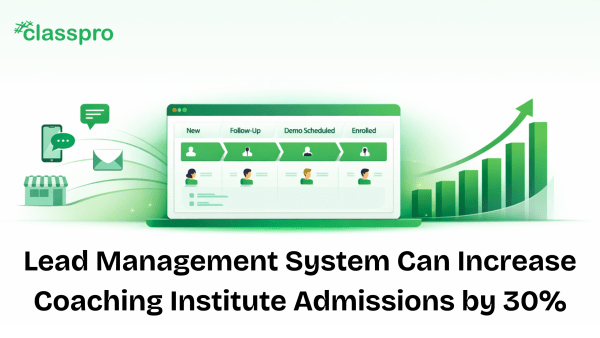


Your ads are running and the phone keeps ringing. WhatsApp pings all day, and the walk-in register fills up by noon. Yet at month end, the admission count barely moves. In most centres, the problem sits in student lead management, not in marketing. Somewhere between the first enquiry and the fee receipt, interested students slip away.
This guide shows where those enquiries leak and how a lead management system plugs the gaps. You will see the five stages every lead should move through. You will also get a worked example that shows the 30% maths honestly. Finally, you will get a checklist for choosing the right software.

Student lead management: The quick answer
Student lead management means tracking every enquiry until the student joins or says no. A lead management system does this work in one place, instead of registers and chats. It captures each enquiry, reminds counsellors to follow up and shows who converts. Most coaching institutes don’t need more enquiries first. They need to convert more of the enquiries they already get.
In short, a good system helps you do four things:
- Log every enquiry from walk-ins, calls, forms, ads and WhatsApp in one list.
- Reply within minutes, then follow a fixed call and message sequence.
- Move each lead through clear stages, from new enquiry to fee paid.
- Track conversions by counsellor, course and lead source every week.
Where coaching admissions leak
Most owners count how many enquiries come in. Far fewer check what happens to each one next. That gap is where admissions disappear. If you still need more enquiries, our guide on leads for coaching institutes covers that side. Here are three student lead management leaks we see most often in coaching centres.
Slow first replies
A parent who enquires today often calls two other centres the same evening. So the first institute to reply with real answers has the edge. Slow replies are common, even among large institutions. UPCEA’s 2025 secret shopper study of US colleges found that 44% of enquiries got no reply. In that study, the average reply took over 14 hours.
Coaching centres face the same risk during admission season. A counsellor who handles 40 calls a day will miss some callbacks. As a result, the family joins whoever called back first.
Notebooks, sheets and personal WhatsApp chats
Enquiries often live in five places at once. Some sit in the walk-in register and some in a Google Sheet. Others stay inside a counsellor’s personal WhatsApp. When that counsellor goes on leave, the history goes with them. Nobody can say who last called the parent who asked about scholarships.
This scattered setup also hides your real numbers. You can’t fix a leak you can’t measure. So the first job of any system is one list with every enquiry in it.
No follow-up after the first call
In our experience, most admissions close on the third or fourth touch. Yet counsellors naturally chase fresh leads, because those calls feel easier. Older leads, the ones that need a nudge, slowly go cold. A parent who said “call me after the exams” often never hears from you again.
The 5 stages of coaching lead management
Good student lead management moves every lead through the same five stages. Clear stages stop leads from sitting in a vague “interested” pile. They also tell each counsellor exactly what to do next. Here is a simple pipeline that works for most coaching centres.
| Stage | What happens | What your system should do |
|---|---|---|
1New enquiry |
A student or parent calls, walks in, fills a form or sends a message | Log the enquiry, note the source and assign a counsellor |
2Contacted |
A counsellor speaks to the family and notes the course, batch and concerns | Save call notes and set the next follow-up date |
3Demo booked |
The student books a free demo class or a counselling visit | Send a confirmation, then a reminder the day before |
4Fee pending |
The family liked the demo but hasn’t paid yet | Remind the counsellor and share fee or instalment details |
5Enrolled or closed |
The student joins, or the family says no | Move the student into a batch, or record the lost reason |
At the fee pending stage, clear instalment plans and fee reminders help families decide. Also record a reason every time you close a lead as lost. Over a season, those reasons show patterns. For example, “fees too high” and “batch timing” need very different fixes.
How a lead management system lifts admissions by 30%
A lead management system doesn’t create new enquiries. Instead, it helps you convert more of the enquiries you already paid for. Five student lead management habits do most of the work.
1. Capture every enquiry in one place
Start by sending every enquiry into one list. That includes walk-ins, calls, website forms, ad forms and WhatsApp messages. WhatsApp deserves special care in India. Meta cites a 2025 Kantar study of online adults in India. It found that 91% chat with a business every week.
So a WhatsApp lead needs the same tracking as a walk-in. Classpro’s enquiry and lead management module logs each enquiry with its source and joining status. Its website enquiry plugin also alerts your team when a new lead arrives. If you run Google Ads for your institute, send those form leads into the same list.
2. Reply in minutes, then follow a fixed sequence
Speed tells parents that you take their child seriously. So set a simple rule: Every new enquiry gets a reply within 15 minutes during working hours. The reply can be a short WhatsApp message with the brochure and a callback time. Edified’s 2025 Enquiry Experience Tracker rated WhatsApp the most reliable channel for student enquiries. Its mystery shoppers got 80% of WhatsApp replies within two hours.
That study covered 103 universities worldwide. So treat it as a direction, not an Indian benchmark. After the first reply, a fixed follow-up sequence keeps the lead warm. Here is one we suggest:
- Day 0: Send a WhatsApp reply with the brochure, then call within the hour.
- Day 1: Call again and offer a free demo class slot.
- Day 3: Share a topper story or recent mock test results from your centre.
- Day 7: Call to answer fee and batch questions.
- Day 14: Send a final check-in before you close the lead.
Free demo classes remain one of the best ways to increase students, so book them fast. Notifications and reminders keep this sequence on time. Counsellors see who is due today, instead of relying on memory. As a result, no parent waits a week for a promised callback.
3. Sort leads by intent
Some enquiries are far more ready to join than others. A parent who asks about fees and batch timings is a hot lead. A student who only wanted a brochure is warm at best. So tag each lead as hot, warm or cold after the first call. Then counsellors call hot leads first each morning, instead of working down the list.
4. Remember every conversation
Parents notice when a counsellor remembers details. Imagine a counsellor who calls back and mentions the NEET weekend batch the parent asked about. That one line builds more trust than any brochure. The same Edified study found that warm, tailored replies beat quick, generic ones. Students were seven times more likely to keep engaging after a tailored reply.
Parents compare several centres before they decide. Our guide on how parents discover coaching centres explains this in detail. A central record lets every counsellor give that personal touch, not only your best one. Call notes, course interest and concerns all sit on the lead’s profile. After the student joins, the student and parent app keeps that relationship going.
5. Track conversions by counsellor
Many institutes stall because growth depends on the founder. If you aren’t in the office, callbacks slip and registers go stale. A dashboard fixes this, because it shows conversions for each counsellor, course and lead source. For example, Counsellor A may convert 20% of leads while Counsellor B converts 8%. That gap tells you who needs coaching and which calls to review.
Good coaching lead management needs a 20-minute review every Monday. Check new leads, overdue follow-ups, demos booked and admissions closed. Classpro’s reports show where your admissions pipeline stands, so you spot the bottleneck early.
The 30% maths: A worked example
Here is how a 30% lift actually works. The 30% means relative growth, not 30 extra percentage points. The numbers below describe a sample institute, not a real client. So use them as a template for your own figures.
| Metric | Before | After |
|---|---|---|
| Enquiries per month | 200 |
200Same ad spend |
| Conversion rate | 10% |
13%+3 points |
| Admissions per month | 20 |
26+6 students |
| Extra admissions | Nil |
630% more |
The three extra percentage points come from small, realistic gains. In our experience, the split could look like this:
- Faster first replies: About 1 point, because fewer families join elsewhere first.
- A full follow-up sequence: About 1.5 points, because you revive leads that went quiet.
- Demo class reminders: About 0.5 points, because fewer students miss their demo.
Now put a rupee value on it. At an average course fee of ₹40,000, six extra students bring in ₹2.4 lakh each month. You get that without raising the ad budget. Your own fees and conversion rates will differ, so run this maths with your real data.

Manual tracking vs a lead management system
Registers and spreadsheets work when a handful of enquiries arrive each week. Past that point, they start losing leads quietly. Here is how the two approaches compare on the jobs that matter.
| Job | 📒 Manual tracking | ⚡ Lead management system |
|---|---|---|
| Capturing enquiries | Spread across registers, sheets and phones |
One list with the source of every lead |
| First reply | Depends on who is free |
Instant alert and a set reply time |
| Follow-ups | Counsellor memory and sticky notes |
Reminders on each due date |
| Staff changes | History leaves with the counsellor |
Full notes stay on each profile |
| Counsellor performance | Guesswork |
Conversion rate per counsellor |
| Lost reasons | Rarely recorded |
Tracked and reported |
| Owner visibility | A surprise at month end |
A weekly pipeline view |
Common student lead management mistakes
Even with software, a few habits undo the gains. Most of them come down to discipline, not tools. Watch for these mistakes in your first month:
- Letting counsellors keep leads on personal phones. Move every chat into the shared system.
- Closing a lead after one missed call. Families are busy, so try three times at different hours.
- Skipping the lost reason. Without it, you can’t tell a pricing problem from a timing problem.
- Tracking only admissions. Also track reply time and demo attendance, since both predict admissions.
- Adding too many fields. Keep the form short so counsellors actually fill it in.
How to choose admission lead management software
Generic sales CRMs can work, but they rarely fit a coaching centre’s rhythm. You deal with batches, demo classes, parents and fee instalments. So look for a CRM for coaching institutes that covers these basics:
- Enquiry capture from walk-ins, calls, website forms and ad forms.
- Follow-up reminders with due dates for each counsellor.
- WhatsApp or SMS messages to parents from inside the system.
- Stage tracking from new enquiry to enrolled, with lost reasons.
- Reports by counsellor, course and lead source.
- Fees, attendance and parent updates in the same software.
The last point matters more than it looks. When leads, fees and attendance live together, a new admission moves straight into a batch. Nobody retypes the student’s details. Our guide to the best coaching institute management software covers the wider buying checklist.
What about free tools? A shared Google Sheet still beats a paper register. However, free tools rarely send reminders or connect leads to fees and batches. In our experience, most institutes outgrow them once enquiries pass about 50 a month.
Start with the leads you already have
Admissions growth mostly comes down to student lead management. Before you raise next season’s ad budget, check last month’s enquiries. How many got a reply within the hour? How many got a second call or a demo reminder? Those answers show how much growth already sits in your list.
Classpro brings enquiries, follow-ups, fees and attendance into one app built for coaching centres. Start your free trial and run your next batch of enquiries through it. You can also compare plans and pricing before you decide.
Frequently Asked Questions
What is student lead management?
Student lead management is how an institute tracks each enquiry from first contact to enrolment. It covers the first reply, follow-ups, demo bookings and fee collection. A lead management system automates the reminders and keeps every note in one place.
What are the five stages of lead management?
The five stages are: New enquiry, contacted, demo booked, fee pending and enrolled or closed. Each stage has one clear next action for the counsellor. A lost reason at the final stage helps you fix recurring problems.
What is the 5-minute rule for leads?
The 5-minute rule is a common sales habit: Reply to a new lead within five minutes. It works because families are most interested right after they enquire. For coaching centres, we suggest an instant WhatsApp reply, then a counsellor call within the hour.
Which is the best CRM for coaching institutes?
The best CRM for coaching institutes tracks enquiries, demo classes, fees and batches together. Generic sales CRMs miss those coaching-specific steps. So shortlist tools built for education, then test them on real enquiries during a free trial.
What is the ideal response time for converting coaching enquiries?
The ideal response time for a new student enquiry is within 4–6 hours. Institutes that respond within the first few hours dramatically increase their chances of conversion. When response time drops from 48 hours to under 6 hours, enrollment probability increases significantly because students perceive higher professionalism and urgency.
Is admission lead management software worth it for a small institute?
Usually yes, once enquiries outgrow one person’s memory. Work out the fee from one extra admission and compare it with the yearly software cost. If one saved admission covers that cost, the software pays for itself.