




Behind every successful tuition center is not just great teaching, but also an immense amount of behind-the-scenes work. Many educators find themselves spending a significant part of their time on administration, often wishing they had a robust tuition management system to help. They deal with tasks like fee collection, attendance tracking, and managing records. As a result, they spend up to 30%-40% of their time on operations instead of focusing on students. The result? Less energy for teaching and more stress in managing day-to-day activities. Obviously, this would result in a stressful environment for both staff and students.
To understand how this challenge can be tackled more effectively, we sat down with Mr. Jayesh Gopalan, co-founder of Classpro. Classpro is a platform designed to streamline tuition/coaching management. It gives educators the tools they need to save time. It helps build stronger trust with parents. It also delivers the best learning experience for students. In this interview, Mr. Jayesh shares his insights on why the right system can be a game-changer for tuition centers.
Q&A with Mr. Jayesh Gopalan, co-founder of Classpro
Can you share how Classpro was started and what inspired you and your co-founders to create this platform?
Classpro began in 2011 when Vijay Suryawanshi, Deepak Dargade, and I noticed how inefficient management processes were in coaching classes. Many institutions were spending too much time and money on manual tasks like tuition fee collection and registrar attendance tracking. With our experience in coaching, we wanted to develop a solution that would automate these everyday operations. Our goal was simple. We wanted to design a powerful tuition management system that allowed instructors to focus on teaching rather than office work.
What are the biggest challenges coaching institutes face when managing operations manually?
Coaching institutes face multiple challenges without a proper management system. Attendance tracking can be time-consuming and prone to errors. Fee collection becomes stressful and inconsistent, and communication with parents is often delayed or unclear. Enquiries and enrollments are often handled via multiple channels, leading to lost leads or delays. As institutes grow, these manual systems make it difficult to scale efficiently. This leaves educators overwhelmed and impacting the overall student experience.
In your view, what makes Classpro a game-changer for coaching institutes and educators?
Classpro is a game-changer because it goes far beyond automating routine administrative tasks. It provides a centralized platform where owners can manage every aspect of their coaching institute efficiently. Institutes with multiple branches can track performance in real-time. This way they can receive detailed reports for individual branches as well as consolidated reports across all locations. This gives management a clear view of enrollment trends, class performance, and revenue metrics at a glance.
Classpro also simplifies daily operations for teachers and staff. They can enter student information, schedule classes, manage batches, and assign subjects—all from one system. Enquiries from prospective students are captured in a single dashboard. Hence, making it easy to follow up, convert leads, and close enrollments efficiently.
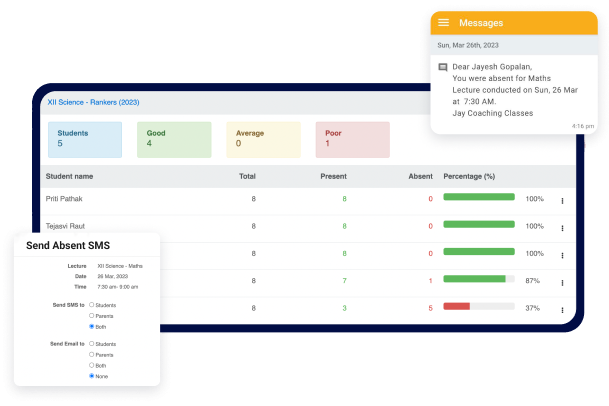
Attendance management is fully automated through biometric systems, reducing manual tracking and errors. Fee collection is automated as well, with reminders and payment tracking handled within the software. Thus, saving time and improving cash flow. One-click notifications to students and parents keep everyone informed about attendance, fees, schedules, and important announcements, eliminating communication delays.
With these features, Classpro not only saves hours of manual work but also ensures better organization. Plus, there is good coordination across branches, and a more structured experience for students and parents. By centralizing operations, automating key processes, and providing real-time insights, Classpro allows educators to focus on teaching, mentoring and preparing students for future endeavours.
Can you share an example of how Classpro has transformed a coaching institute’s operations?
One client was handling over 300 students manually and constantly facing delays in fee collection. After adopting Classpro, they automated reminders, introduced online payments, and improved collection efficiency by more than 40 percent. Teachers could manage classes, batches, and subjects directly from the platform, while management received detailed branch-wise performance reports. The owner told us it felt like they had regained several hours of their day to focus on teaching and improving the student experience.
Some educators may not be tech-savvy. How does Classpro make adoption simple while still providing powerful features?
We designed Classpro to be intuitive and easy to use. Onboarding and training are straightforward, and educators can start with core features like attendance or fee management. The goal is to make technology an enabler, not a hurdle, so educators feel supported rather than overwhelmed. Also, we have a strong support team. They are always available to hand-hold the institute owners. That way, transitioning to a tuition management system becomes easier.
How does Classpro improve the experience for students and parents?
Students benefit from a more organized learning environment with fewer administrative interruptions. Biometric attendance ensures accurate tracking without disrupting classes, and automated notifications keep students informed about schedules and announcements. Parents gain transparency through instant access to attendance records, fee updates, and progress reports. Fee reminders and updates are automated, reducing confusion and improving communication. This creates trust and strengthens the learning ecosystem by keeping everyone connected in real-time.
With AI and automation changing education, how do you see platforms like Classpro evolving in the next few years?
Tuition management systems are already streamlining operations. They offer multi-branch reporting, automated notifications, chatbots, and data-driven insights. The next wave of evolution will make these platforms even more intelligent and proactive. I see AI enabling predictive analytics that can predict student learning gaps. It will also suggest personalized intervention plans, and even recommend optimized teaching techniques for specific batches.
Tuition management systems will integrate more deeply with learning tools. Educators will be capable of tracking more than just administrative metrics. They can monitor academic progress in real time. This includes assignment performance, quiz results, and engagement levels. Automated performance benchmarking across branches can help management decode best practices and replicate success across locations.
Additionally, AI-driven workflow automation can go beyond admin tasks. it can assist with resource allocation, teacher scheduling, and demand forecasting for new courses.
In short, the future of tuition management systems is about making data actionable. It is also about customizing learning at scale, and turning operational insights into strategic decisions. Thus, helping educators focus more on teaching and growth rather than just management.
What advice would you give to educators who are hesitant to move from manual systems to digital management?
Start small. Even adopting a single module like fee management or attendance tracking can save hours of work and demonstrate clear benefits. Once the institute sees the time saved and operational improvements, expanding to other features becomes natural. The key is to embrace change before inefficiencies start holding your institute back. Digital management not only saves time but also improves the student and parent experience, which ultimately drives growth and success.
Technology is not here to replace educators. It is here to empower them. As Mr Jayesh shared, the right tuition management system does more than save time. It transforms the way coaching institutes operate, communicate, and grow. For educators, that is not just a game-changer. It is the future.