


Key takeaways
- Dropouts begin with silence, not with a phone call. Most students go quiet for weeks before they leave.
- Attendance warns you first. A 2026 study of 248,169 students in Chile found attendance predicts dropout better than marks.
- Parents decide, so speak to them monthly. In a 2026 Hanover Research survey of 1,031 US parents, 63% said communication quality shaped their choice.
- Ten quiet exits can cost more than a year of ads. Do the rupee math once, and your Monday routine changes.
- The seven moves below need no new budget. You can start the first three this week.
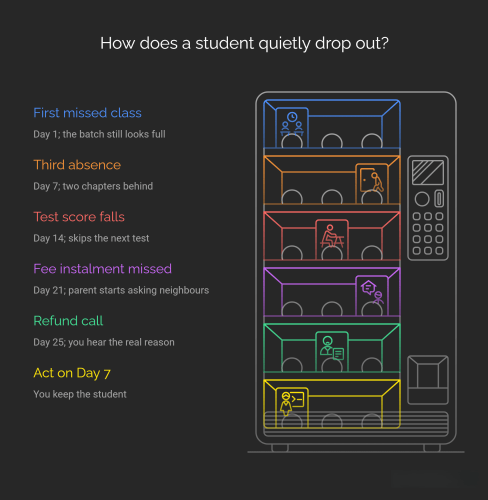
It is week three of the new batch. Rahul’s seat sits empty for the fourth day running. Nobody calls him, because the batch still looks full. Three weeks later his father asks for a refund. You hear the real reason for the first time.
That gap between the first missed class and the refund call is where you lose students. Nobody acted during those three weeks. Close that gap, and you keep most of them.
Student retention strategies: The quick answer
Here is how to reduce student dropouts, step by step:
- Track attendance daily, then act on the third absence.
- Give every batch a named mentor, not just a teacher.
- Send parents a monthly progress update, not a termly one.
- Offer a fee instalment before the student disappears.
- Run a 15-minute exit-risk review every Monday.
- Celebrate improvement, not only rank.
- Ask every leaver why, then log the answer.
Why do students drop out of coaching institutes?
Students rarely leave over one bad class. They leave after a slow slide that nobody names out loud. Research backs this up. A May 2026 study in the International Journal of Educational Development looked at Chile. It tracked a full national cohort of 248,169 students.
The study found that dropout follows a long process of disengagement. Attendance predicts that process better than marks do. The pattern looks the same in Indian coaching centres. The setting differs, but the slide does not. Here are the four reasons we hear most often from owners.
The fee reason: The result stops feeling worth the money
Coaching is a serious family expense in India. The India coaching institutes market reached USD 8.1 billion in 2026. That figure comes from IMARC Group’s report, updated in October 2026. Parents watch that spend closely. When a test score dips and nobody explains why, the fee starts to feel heavy.
The confidence reason: The student falls behind and hides it
A student who misses two chapters rarely admits it. Instead they sit at the back and stop asking questions. Then they skip the test. By the time you notice, they have already decided to leave.
The attention reason: Nobody noticed the absence
Big batches hide small problems. One empty chair in a room of 60 looks like nothing. But that chair is your clearest signal. Most institutes never act on it.
The parent reason: The family hears nothing until the PTM
Parents in India pay the fee, so parents cancel it too. If their only update arrives twice a year, they fill the gap with guesswork. A neighbour’s opinion then carries more weight than your teaching. That is a trust problem, not a teaching problem.
Spot the exit before it happens
Five signals, what each one usually means, and the move to make this week.
| Warning signal | What it usually means | What to do this week |
|---|---|---|
| Three absences in a row | The student feels lost or embarrassed | Call the student, then the parent |
| Test score drops two tests running | A chapter gap opened up | Offer a 30-minute doubt slot |
| Fee instalment misses the due date | Money pressure at home | Offer a revised instalment plan |
| Parent stops replying to updates | Trust is thinning | Book a 10-minute call, not a message |
| Student stops sitting with friends | Social or confidence trouble | Ask the mentor to check in quietly |
What does one dropout actually cost you?
Most owners track admissions closely and exits loosely. That is backwards. An exit costs far more than most owners expect, so let us do the math.
Take a centre with 300 students at a fee of 24,000 rupees a year. Lose 30 students, and you lose 7.2 lakh rupees in one year. You also lose the referrals those 30 families would have sent. Then you spend again on ads to replace them.
Cutting that exit rate from 10% to 6% keeps 12 students. That is 2.88 lakh rupees, earned with phone calls rather than ad spend. Retention costs less than acquisition, every single time.
The wider picture backs this up. India keeps 90.9 students in 100 at the primary stage. At higher secondary that number falls to 58.4. Business Standard reported this from UDISE+ 2024-25 data in August 2026. Only 75.1% of students move from Class 10 to Class 11.
7 student retention strategies that work in Indian coaching institutes
1. Track attendance daily, then act on the third absence
Attendance is the cheapest early warning system you own. Mark it the same day, every day, without exception. Then set one rule: Three absences in a row triggers a call within 24 hours.
Make the call warm, not accusing. Ask what happened, and listen. Biometric attendance removes the register delay. So the alert reaches you while the problem is still small.
2. Give every batch a named mentor, not just a teacher
A teacher covers the syllabus. A mentor notices the quiet student. Assign one faculty member to every 25 students, and tell the students who that person is. Then give the mentor 20 minutes a week for check-ins.
This single habit separates growing institutes from flat ones. We cover it in our post on what every thriving coaching institute does. In our experience, mentored students raise doubts six weeks earlier.
3. Send parents a monthly progress update, not a termly one
Parents who hear from you stay with you. Hanover Research surveyed 1,031 US K-12 parents in July and August 2026 for ParentSquare. In that survey, 63% said communication quality influenced their decision to stay. Nearly one in four rarely heard anything about their child’s attendance.
That finding comes from US schools, not Indian coaching centres. Still, the lesson travels. Send a short monthly note with attendance, the last two test scores and one comment. A student and parent app does this automatically, and reminders and notifications handle the rest. Pair it with a proper PTM that keeps students enrolled.
4. Offer a fee instalment before the student disappears
Money problems rarely arrive as a question. They arrive as a missed due date, then an empty seat. So watch your overdue list like an attendance register.
Call the parent on day three of a late fee. Offer two or three smaller instalments instead of one lump sum. Most families accept, and most stay. Our guide to fee structure and instalments shows how to design this. Then fee management sends the reminders for you.
5. Run a 15-minute exit-risk review every Monday
Set a fixed slot every Monday morning. Pull three lists. First, students with three or more absences. Second, students whose scores fell twice. Third, parents with overdue fees.
Name one owner for each student on those lists. Keep the meeting to 15 minutes. The point is action, not discussion. Reports and dashboards can build these three lists before the meeting starts.
6. Celebrate improvement, not only rank
Toppers do not leave. The student who moved from 32 to 48 marks might. So build a monthly “most improved” list and read it out in class.
Send that news home the same day. A parent who reads good news about an average child becomes your strongest supporter. Student performance tracking makes these jumps visible. That is where most institutes stop looking.
7. Ask every leaver why, then log the answer
Every exit carries free information, and most institutes throw it away. Call every student who leaves within three days. Ask one open question: Why did you decide to stop?
Write the answer in one line and tag it. After 20 exits your real pattern appears. It is usually fees, timings, a teacher or distance. Keep these records in your enquiry and lead system, because many leavers return next year.
Mistakes that quietly raise your dropout rate
- Waiting for the PTM to raise a problem. Six weeks of silence is six weeks of drift.
- Calling the parent before the student. The student knows the real reason first.
- Offering a discount as the first fix. Discounts solve money problems, not confidence problems.
- Counting only admissions in your monthly review. What you do not measure, you do not fix.
- Letting the biggest batch run without a mentor. Large batches hide the most risk.
How to measure your student retention rate
University formulas do not fit a coaching batch. A college measures year-on-year persistence. You need a simpler number that works across nine months.
Use this formula. Your retention rate equals students who finished the batch, divided by students who started it. Multiply that by 100. A batch that starts with 60 and ends with 54 gives you 90%.
Track three numbers every month:
- Monthly exit count. How many students left this month?
- Exit reason tags. Which reason appeared most often?
- At-risk count. How many students sit on your Monday list?
Review these three alongside your admission numbers. Put them on the same page. In our experience, monthly reviewers cut exits faster. Yearly reviewers notice the problem too late.
Your first 30 days
Your first 30 days
One move a week. Each week builds on the one before it.
| Week | What to do |
|---|---|
| Week1 | Start daily attendance marking and set the three-absence rule Takes 10 minutes a day |
| Week2 | Assign a named mentor to every batch and tell students who it is One mentor per 25 students |
| Week3 | Send the first monthly parent update and start the Monday review Attendance, two scores, one comment |
| Week4 | Call your last 10 leavers and log why each one left Tag every reason in one line |
By day 30 you will know your real exit reason, not your guessed one.
Keep the students you worked so hard to admit
Retention is quieter work than marketing, and it pays better. Every student you keep saves you one admission you no longer need to chase. Start with attendance this week, then add the mentor next week.
Want these alerts, updates and reports to run on their own? Start your free Classpro trial and set them up in a day. You can also compare plans and pricing to see what fits your centre. For more growth ideas, read our guide on how to increase students in coaching and tuition classes.
FAQs
What are the best student retention strategies for a small coaching institute?
Start with three: Daily attendance tracking, a named mentor per batch, and a monthly parent update. These three need no software spend to begin. Add the Monday exit-risk review once the first three become a habit.
What is a good student retention rate for a coaching institute?
Most Indian centres we work with keep 85% to 92% of a batch from start to finish. Below 80% signals a fixable problem. Measure your own rate first, then aim to improve it by four points a year.
What are the main student dropout reasons in coaching classes?
Four reasons cover most exits. These are fee pressure, falling behind, feeling unnoticed, and weak parent communication. A demo class that sets honest expectations prevents some of these from the start.
How early can you spot a student who is about to drop out?
Usually three to four weeks early. Three absences in a row signal it. So do two falling test scores and one late fee. Act on any one of those signals within 48 hours.
Should I call the student or the parent first?
Call the student first, because they know the actual reason. Then call the parent with a plan, not a complaint. Parents respond far better when you arrive with a solution.
Does software actually reduce dropouts?
Software does not keep students. People do. But attendance alerts, fee reminders and parent updates make sure your team acts on time, every time.