


It is Saturday morning. Eleven families booked a demo class at your institute this week. Six turn up. Two join.
You taught well. The topic landed. Still, nine families walked away without a decision.
Most owners blame the teaching when this happens. The real gap usually sits around the class, not inside it. A demo class for coaching converts when three things line up. The booking, the room, and the follow-up must work together. This guide walks you through each one.
Demo class for coaching: The quick answer
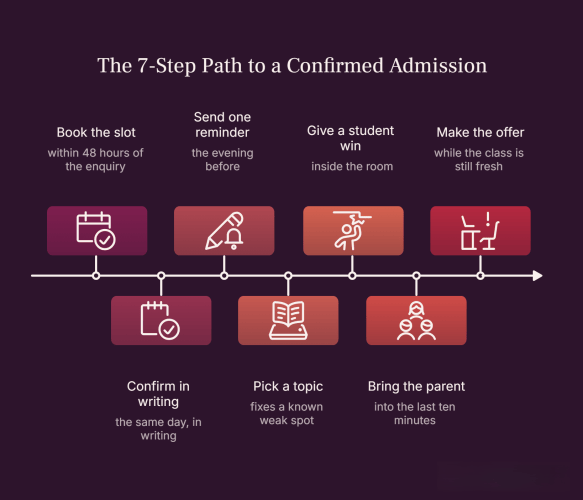
A demo class for coaching turns into an admission when you do seven things in order:
- Book the slot within 48 hours of the enquiry.
- Confirm the slot the same day, in writing.
- Send one reminder the evening before.
- Pick a topic that fixes a known weak spot.
- Give the student a win inside the room.
- Bring the parent into the last ten minutes.
- Make the offer within 48 hours of the class.
Skip any one of these and the demo leaks. Most institutes do five of the seven well. The two they miss cost them the admission.
Why most demo classes never become admissions
Three leaks drain almost every demo funnel. Owners usually notice only the last one. Each leak needs a different fix. So it helps to name them separately.
- The no-show leak drains the most families. A parent books on Monday for a class ten days away. Interest fades, another institute calls, and they never arrive.
- The flat demo leak looks like success. The student sits through a good lecture and leaves impressed. Nothing changed for them personally, so they stay undecided.
- The silence leak is the easiest to fix. Nobody calls after the class. The family compares three more institutes and forgets you.
Competition keeps raising the cost of each leak. IMARC Group puts the India coaching institutes market at USD 8.1 billion in 2026. That is up from USD 7.2 billion in 2025. More institutes mean more free demo invitations in every parent’s phone.
Demand is strong on the other side too. The government surveyed Indian households between April and June 2025. That Comprehensive Modular Survey on Education found 27% of students take private coaching. In urban India the figure reaches 30.7%. Your job is to stop losing those families.
Before the demo: Lock in the attendance
Attendance decides everything else. A brilliant class with four empty chairs still produces nothing. These three steps protect your show-up rate.
1. Book the slot within 48 hours of the enquiry
Speed matters more than polish here. The family is comparing institutes right now, not next week. So offer a specific demo slot in your first conversation. A vague invitation gives them nothing to commit to.
Most businesses lose this race. Blazeo studied 573 service businesses in the United States during 2026. Its 2026 benchmark report found 74% do not reply to new leads within five minutes. Indian coaching counsellors face the same problem during admission season.
Give your team a simple rule. Every enquiry gets a callback within 30 minutes during working hours. Every callback ends with a date, a time, and a teacher’s name. Log each one in a single place, such as Classpro’s Enquiries and Lead Management. Our guide on how a lead management system increases admissions shows where these calls break down.
2. Confirm the slot the same day, in writing
A verbal yes on a phone call fades by evening. A written confirmation gives the family something to look at. It also makes the appointment feel real.
Send a short message within an hour of the call. Include the date, time, address, teacher name, and topic. Ask for a one-word reply to confirm. That reply is your strongest signal before the class. Our WhatsApp message templates for coaching institutes include wording you can copy.
3. Send one reminder the evening before
One reminder lifts attendance. Three reminders feel like pressure. Send yours between 7 pm and 9 pm the night before.
Keep the message short and warm. Repeat the time and the topic. Then add one line about what the student will learn. Offer an easy way to reschedule, because a rescheduled family is still a live lead. Automated notifications and reminders handle this without anyone remembering.
During the demo: Teach one thing well
A demo class is not a syllabus tour. The family already assumes you can teach. They came to find out whether this place suits their child. Knowing how to conduct a demo class comes down to three choices.
4. Pick a topic that fixes a known weak spot
Ask one question during the booking call. Which chapter does your child struggle with most? Then build the demo around that answer.
This changes the whole experience. A general lecture on motion is forgettable. A 45-minute class that finally makes projectile sums click is not. In our experience, demos built on a stated weak spot convert far better. Keep the class to 45 or 60 minutes, because longer demos tire students.
5. Give the student a win inside the room
Plan one moment where the student solves something alone. Set a short problem in the last 15 minutes. Walk the room, help quietly, then let them finish it.
That small win does the selling for you. The student leaves with proof that your method works. No brochure creates that feeling. Also avoid one common error here. Do not spend the demo praising your toppers.
6. Bring the parent into the last ten minutes
In most Indian families, the parent approves the fee. Yet most demo classes ignore them completely. Fix this with a short, planned conversation.
Invite the parent in for the final ten minutes. Show them the problem their child solved. Explain what you would work on over the next three months. Keep it specific and short.
Then show them how they will track progress after joining. A parent app with test scores and attendance answers a silent question. Our post on how regular updates grow coaching institutes covers this habit. Parents who feel informed say yes faster.
After the demo: Close inside 48 hours
The demo creates a feeling. That feeling fades fast. Your demo class follow up decides whether it becomes a fee receipt.
7. Make the offer while the class is still fresh
Call within 24 hours, and never later than 48. Open with something specific from the class. Mention the problem the student solved by name.
Then give three clear things:
- The plan: Which batch, which timings, and what you will cover first.
- The fee: The full amount, the instalment option, and the start date.
- The deadline: A seat held for a stated number of days, honestly applied.
A fake deadline costs you trust. A real one helps families decide. So pick a batch start date and hold the seat until then.
Share results at this stage, not during the class. Send two or three verified outcomes from similar students. Your student performance reports make this easy to pull. If fees are the sticking point, offer instalments before the family asks. Flexible fee plans close more admissions than discounts do.
One demo class or a three-day trial batch?
Owners ask this constantly. Both formats work, and they suit different situations. The table below shows the trade-offs.
Single demo class or three-day trial batch: How the two formats compare.
| Factor | Single demo class | Three-day trial batch |
|---|---|---|
| Time to decision | 2 to 3 days | 5 to 7 days |
| Teacher effort | Low | High |
| Show-up risk | One session to miss | Drops after day one |
| Depth of experience | One topic | Teaching style and batch culture |
| Best for | Board and school tuition | JEE, NEET, and long courses |
| Fee objection handling | Needs a separate call | Happens by day three |
Pick the single demo when the course is short or the fee is modest. Pick the trial batch when a family commits to two years. Some institutes run both and let the parent choose.
Five mistakes that kill demo class conversion
These errors show up again and again. We see them across the institutes we work with. Each one quietly lowers your demo class conversion rate.
- Booking the demo too far ahead. A date ten days out doubles your no-show rate. Keep the gap under 72 hours wherever you can.
- Letting your weakest teacher take demos. Demos look like extra work, so they drift to whoever is free. Assign your best teacher instead.
- Teaching a sales pitch. Students notice within five minutes. Teach a real class and let the quality speak.
- Treating a no-show as a dead lead. A free demo class for coaching institute admissions costs the family nothing. So call the next morning and offer another date.
- Keeping no records. Without a log, you cannot tell which stage is failing. Track every stage separately.
Four numbers to track every week
A demo class for coaching only pays off when you measure it. Track these four numbers and the weak link becomes obvious. Review them every Monday with your counselling team.
- Demos booked: Count enquiries that turned into a confirmed slot. A low number means your callback is too slow.
- Demo show-up rate: Divide attendees by bookings. Below 60% points at your reminders, not your teaching.
- Demo to admission rate: Divide admissions by attendees. This is your true demo class conversion number.
- Days to close: Count days from demo to fee payment. Rising numbers mean your offer lacks a clear next step.
Most institutes find one weak stage, fix it, and see results within a month. Classpro’s reports pull these figures without manual counting. Where you source leads also shapes these numbers. Our guide on Google SEO and Google Ads for coaching institutes covers the best channels. For a wider view, read our 11 proven ways to increase students in coaching.
Turn your next demo class for coaching into an admission
A demo class for coaching is your best sales tool. It only works when the whole process holds together. Book fast, confirm in writing, and remind once. Teach one thing well, include the parent, and close in 48 hours.
Start with one change this week. Measure your demo show-up rate first. Then fix whichever step looks weakest.
Classpro helps coaching institutes track every enquiry to confirmed admission. Start your free trial and see where your demos leak. You can also compare plans and pricing for your institute.
FAQs
What is a demo class for coaching?
A demo class for coaching is a free trial session for a prospective student. The student experiences real teaching before paying any fee. Most institutes run demos of 45 to 60 minutes. Parents often join for the last few minutes.
How long should a demo class be?
Keep a demo class between 45 and 60 minutes. That window gives you time to teach one concept properly. It also leaves room for the student to solve a problem alone. Longer sessions tire students and rarely improve your results.
Should a demo class for coaching be free?
A free demo class for coaching institute admissions removes the risk for a hesitant family. Most Indian institutes offer demos free for this reason. Some charge a small refundable amount to cut no-shows. Adjust your approach to your booking numbers, not your costs.
What should you teach in a demo class?
Teach the topic the student finds hardest. Knowing how to conduct a demo class starts with that choice. Ask about their weak chapter during the booking call. A targeted class proves your value far better than a syllabus overview.
How do you follow up after a demo class?
Call within 24 hours, and never later than 48. Mention something specific the student did in class. Then share the batch plan, the fee options, and a real seat deadline. A good demo class follow up turns interest into a decision.