

Key takeaways:
- CBSE released the 2027 date sheet on 6 November 2026. Class 10 and Class 12 papers both begin on 16 February 2027. So a crash course for board exams has roughly 12 usable weeks left.
- Work backwards from the paper dates, not from a round number of weeks. Class 10 Maths falls on 17 February 2027, and Social Science falls on 8 March 2027. That three-week gap decides which subject you revise last.
- Class 10 now carries a second board exam in May. In 2026, 5,13,955 students sat it to improve, and 59.95% of them scored higher. Plan your April batch now, not in March.
- Price against what families already spend. Government survey data puts average yearly coaching spend at ₹6,384 per higher secondary student across India.
- Treat the crash course as an admission channel. Book the next-year counselling call before the last paper, never after the result.
Every January, the same thing happens in coaching centres across India. The owner announces a board exam crash course. Thirty seats go on the poster, and eleven fill. The course runs well, students pass, and then everyone leaves in April. This guide fixes that pattern, so your batch fills early and feeds next year’s admissions.
What is a crash course for board exams?
A crash course for board exams is a short, intense revision programme before the board papers. It usually runs for 6 to 12 weeks. It covers the syllabus again at speed, with heavy test practice and previous year papers. Coaching institutes run it as a separate paid batch, open to their own students and to outsiders.
Quick answer: To plan a crash course for board exams, start from the official date sheet. Fix your dates by working backwards from each paper. Then cut the syllabus to high-weight chapters, cap the batch, and price it in two instalments. Test every week, share the trend with parents, and book next-year counselling before the last paper.
Why the 2027 board calendar changes your plan
Your window is already short
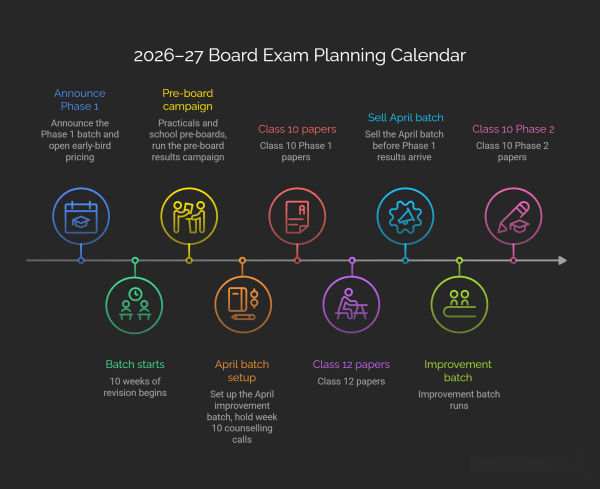
CBSE released the date sheet for 2027 on 6 November 2026. Class 10 papers run from 16 February to 9 March 2027. Class 12 papers run from 16 February to 9 April 2027. Practical exams for regular schools run from 1 January to 13 February 2027.
Count the weeks yourself. From late November, you have about 12 clear teaching weeks. However, January belongs partly to practicals and school pre-boards. So your real teaching window is closer to nine weeks. Your marketing window is closer to three.
Class 10 now gives you two seasons
CBSE began holding Class 10 boards twice a year from 2026, under NEP 2020. The first paper is compulsory. The second one in May stays optional. The higher of the two scores counts.
The 2026 numbers show what this means for your business. CBSE data reported by The Tribune shows 6,63,777 students appeared in the second board exam. Of those, 5,13,955 sat it purely to improve their score. Then 3,08,095 of them, or 59.95%, actually scored higher.
That is a second crash course season sitting in April and May. Most institutes still ignore it. Your Phase 1 students already trust you. So they are the easiest batch you will ever fill.
Families are already paying for coaching
The Ministry of Statistics ran a national education survey between April and June 2025. It found that 27.0% of students took private coaching during the year. In urban areas the figure rose to 30.7%, against 25.5% in rural areas. Meanwhile, IMARC Group values the India coaching institutes market at USD 8.1 billion in 2026.
Spending also climbs with class level. The same 2025 survey puts yearly coaching spend at ₹525 for pre-primary. At higher secondary it reaches ₹6,384 across India. In urban areas, higher secondary coaching spend averages ₹9,950 a year.
Read those numbers as your price ceiling and your floor. A parent already budgets for coaching. So you are rarely selling a new expense. You are asking for a share of a budget that exists.
How to plan a crash course for board exams in 7 steps
1. Fix dates by working backwards from the date sheet
Every crash course for board exams starts with the date sheet, not with a calendar month. Write each paper date on a wall chart. Then place your last revision class two days before each paper. Work backwards from there to find your start date.
The gaps matter more than the start date. Class 10 Maths falls on 17 February 2027. Social Science falls on 8 March 2027. So a student gets three extra weeks for Social Science. Teach Maths hard in January, and hold Social Science capacity for early March.
Announce the exact end date on your poster. Parents trust a course with a finish line. Also, a fixed end date protects your teachers from an open-ended February.
2. Cut the syllabus before you cut the hours
Most crash courses fail because they try to cover everything. Pick the chapters that carry the most marks in the last five papers. Then build the schedule around those chapters only.
Tell students plainly what you will skip. Honesty here builds more trust than a promise of full coverage. For example, say this: “We will not reteach Chapter 3, because it carries six marks.”
Share the skipped chapters as practice sets through Homework and Assignments. Students still get the material. Meanwhile, your class hours go to the chapters that move the score.
3. Cap the batch and protect your regular timetable
Decide the cap before you print anything. A revision batch needs doubt-solving, so 25 students works better than 45. A smaller cap also gives you a real line for your poster.
Then check your teacher load honestly. A crash course usually adds 10 to 14 hours a week per teacher. Teachers who already run full-year batches will burn out by February. Our guide on reducing teacher turnover covers how this damage builds.
Two practical fixes work well. First, hire one part-time teacher for the crash batch only. Second, run the crash course in a slot your regular batches skip. Early morning or Sunday usually works. Track attendance in both batches through Biometric Attendance, so clashes show up fast.
4. Price it against what parents already spend
Start from the national figure of ₹6,384 a year for higher secondary coaching. A 10-week crash course covers a fraction of a year. So price it as a fraction of your annual fee. Most centres land between ₹4,000 and ₹15,000, depending on city and subject count.
Then split the fee into two instalments. One payment at joining, and one in mid-January, removes the biggest objection. Set both reminders inside Fee Management on the day a student joins.
Offer an early-bird price that closes by a real date, such as 20 December. Also give your existing students a clear discount, because they cost nothing to acquire. Our guide on fee structure for hybrid coaching classes covers instalments and discounts in detail.
5. Test weekly and show parents the trend
A crash course for board exams sells on proof, not on hours taught. So run one full-length paper every week from week three. Mark it within 48 hours, and enter the scores the same day.
A single score means nothing to a parent. A trend means everything. Record every test in Student Performance, so the graph builds itself across ten weeks.
Then push that trend out. Send a short weekly update through Notifications and Reminders, or through the Student and Parent App. A parent who sees marks climb from 58 to 74 will recommend you to others.
6. Market it in three windows, not one
Most institutes announce a crash course for board exams once, then go quiet. Three short pushes work far better than one long campaign. Plan each one around a date parents already care about.
- Window one, late November: Announce dates and the early-bird price, right after the date sheet news breaks.
- Window two, late December: Push the last early-bird week, and post a seats-remaining count.
- Window three, early January: Target school pre-board results, when weak scores make parents act.
Post your batch dates on your Google Business Profile in all three windows. Our guide on Google SEO and Google Ads for coaching institutes covers the local search side. Then log every enquiry in Enquiries and Lead Management and call back within 30 minutes.
In our experience, a callback inside half an hour converts far better. January enquiries go cold within a day. The parent is usually calling four centres at once.
7. Plan the April batch before February ends
Class 10 Phase 2 falls in May 2027. So your improvement batch should start in April. That means you must sell it in March, and set it up in February.
Do three things before your last Phase 1 paper. First, tell every Class 10 parent that a second attempt exists. Second, collect interest in writing, not verbally. Third, fix the April batch dates and fee now.
Then, when Phase 1 results arrive, your batch opens on day one. Everyone else will still be printing posters. This habit turns a seasonal crash course for board exams into a yearly revenue line.
A sample 10-week crash course plan
Use this as a skeleton and change the subjects to match your batch. It assumes a Class 10 batch starting in early December. A crash course for class 12 board exam students follows the same shape, with more weeks.
10-week crash course plan
| Week | Teaching focus | Test | Parent update |
|---|---|---|---|
| 1 | Maths: Algebra and Trigonometry | Diagnostic paper | Baseline score shared |
| 2 | Science: Chemical reactions and Acids | Chapter test | Attendance summary |
| 3 | Maths: Geometry and Mensuration | Full Maths paper | First trend graph |
| 4 | Science: Light and Electricity | Full Science paper | Weak-topic list |
| 5 | Social Science: History and Civics | Chapter test | Score comparison |
| 6 | Maths and Science revision mix | Combined paper | Mid-course call |
| 7 | English: Writing and Literature | Full English paper | Trend graph update |
| 8 | Maths: Previous year papers | Timed PYQ paper | Predicted score band |
| 9 | Science and Social Science PYQs | Timed PYQ paper | Final weak-topic list |
| Week 10 | Doubt sessions and exam technique | Mock board day | Counselling call booked |
Notice week 10. The counselling call sits inside the course, not after it. That placement is the whole point.
How to turn crash course students into next year’s admissions
A crash course gives you 10 weeks of daily contact with a new family. That is the most valuable window your centre gets all year. So treat it as an admission channel, not as a one-off sale.
For a crash course for class 10 board exam students, the next step is obvious. They need Class 11 coaching before results arrive. So pitch the Class 11 foundation batch in week nine. They still see you as the reason marks improved.
For Class 12 students, the family itself is the asset. Ask whether a younger sibling studies in Class 8 or 9. In our experience, sibling referrals from a crash batch beat any paid ad.
- Hold a 15-minute counselling call with every parent in week 10, not in April.
- Offer a joining discount that expires before the board result arrives.
- Record the outcome of every call, so nobody slips through in the exam rush.
Our guide on why student counselling matters explains how to run these conversations. For broader tactics, read our post on how to increase students in coaching. Both pair well with a board exam crash course.
Mistakes to avoid when you plan a crash course for board exams
- Starting too late: A January start for a board exam crash course leaves no room for weekly tests. Parents then see hours, not progress.
- Promising full syllabus coverage: You cannot reteach a year in eight weeks. An honest chapter list sells better than a false one.
- Ignoring the date sheet gaps: Treating every subject as equally urgent wastes your best weeks.
- Pricing by gut feel: Guesswork leaves money on the table, or it scares parents away.
- Letting teachers absorb the extra load: Burnt-out teachers in February cost you the next academic year.
- Skipping the April batch: Class 10 improvement demand is now proven, and most centres still ignore it.
- Counselling after results: By then the family has already visited three other centres.
How to measure whether your crash course worked
Measure five things. Pull four of them from Reports, and track the fifth by hand. Write the numbers down at the end of every season.
What to measure after every crash course
| Metric | How to read it |
|---|---|
| Batch fill rate | Seats filled against your cap. Below 70% means your marketing started too lateHealthy: 70% or above |
| Mock score change | Average marks in week 10 against week 1. Aim for a 12-mark lift or betterTarget: plus 12 marks |
| Attendance in the last three weeks | A drop here warns you that students have switched to self-studyWarning sign |
| Fee collection on time | Late instalments in January usually mean your split was wrongWarning sign |
| Conversion to next year | Crash students who join a regular batch. This is the number that compoundsThe number that matters most |
Record all five at the end of every season, then compare them next year.
Most owners run a crash course for board exams on memory. A simple record puts you ahead quickly.
Fill your next crash batch without the admin mess
The teaching part of a crash course for board exams is the part you do well. The planning, fee follow-up, weekly scores, and parent updates eat your February. Every one of those tasks can run itself.
Set up your crash batch, fee instalments, and test schedule in one place this week. Then start a free Classpro trial and build the April batch beside it. You can also check plans and pricing before you decide.
FAQs
When should a crash course for board exams start?
Start 10 to 12 weeks before the first paper. For the 2027 CBSE boards, that means a late November or early December start. A January start leaves too little room for weekly full-length tests.
How long should a board exam crash course run?
Most work well at 8 to 12 weeks. Shorter than six weeks becomes a doubt-clearing camp, not real revision. Longer than 12 weeks tends to lose student attention before the papers.
How many students should a crash course batch have?
Cap it at 20 to 30 students for a revision batch. Students join a crash course for doubt-solving, which needs teacher attention. A smaller cap also becomes a genuine selling point in your marketing.
How much should I charge for a crash course for board exams?
Price it as a share of your annual fee, then check it against real spending. Government data puts average annual coaching spend at ₹6,384 per higher secondary student. Most centres land between ₹4,000 and ₹15,000, depending on city and subject count.
How does a crash course for class 10 board exam differ from Class 12?
Class 10 covers fewer subjects, so eight weeks often works. A crash course for class 12 board exam students needs longer. Papers run to 9 April 2027. Class 12 batches also need stream-wise groups, which raises your teacher cost.
Should I run a crash course for the Class 10 second board exam?
Yes, and the demand is now proven. In 2026, 5,13,955 Class 10 students sat the second exam to improve. Nearly 60% of them scored higher, so parents already see the value.
How do I keep crash course students for the next academic year?
Pitch the next batch in week nine, before board results arrive. Hold a short counselling call with every parent in the final week. Also offer a joining discount that expires before the result date.
Can software help me run a crash course for board exams?
Yes, because the admin load doubles during crash season. Coaching software handles batch setup, fee instalments, attendance, test scores, and parent updates. Classpro covers all five, so your teachers stay on teaching.