


A Class 11 student stops answering in class. Her marks drop sharply across two tests. Her parents ring you, worried and upset. Nobody at your centre knows what changed. Student counselling in coaching institutes exists to catch moments like this early.
What is student counselling in coaching institutes?
Student counselling in coaching institutes means planned sessions on career choice and student wellbeing. A United Nations backed study covered 21,239 Indian students in Classes 9 to 12. Only 10.4% of them received professional career guidance. Since July 2025, the Supreme Court requires coaching centres to run structured career counselling. So counselling is now a legal duty, not a goodwill gesture.
You already have the advantage here. Your students sit in your classrooms for two to four hours a day. Your teachers see their marks, their mood and their attendance every week. A school counsellor meets the same child twice a year, if at all.
That daily contact is the whole point. You notice a drop before a parent does. You can act on it within the same week. Counselling simply turns that noticing into a routine your team follows.
Why does counselling matter so much in 2026?
Counselling matters because most Indian students pick a career without any guided help. The same UN backed study, reported in September 2025, covers this too. It found that 81% of students face barriers to career decisions. Only 22% of them had a backup plan. For a coaching owner, that gap is also a retention problem you can fix.
The numbers behind the gap are worth keeping in front of you:
- Guidance is rare: Just 10.4% of students in Classes 9 to 12 get professional career guidance.
- Confusion runs high: 41% of private school students feel unsure about their course. The government school figure is 35%.
- Costs are a blind spot: Only 10% of students know what their intended course costs.
- Backup plans barely exist: Only 22% of students have a second option in mind.
Stress sits on top of that confusion. A 2025 study in the Asian Journal of Psychiatry surveyed 1,628 Indian students aged 18 to 29. It covered eight Tier 1 cities. Moderate to high anxiety showed up in 69.9% of them, and depression in 59.9%. Those students are older than your batches, so read it as a direction.
The business case follows the student case. A confused student drops out quietly in month four. A guided student renews, and tells three friends. Our customers tell us that parents ask about mentorship long before they ask about results.
What do the Supreme Court guidelines ask coaching institutes to do?
The Supreme Court made counselling binding for coaching centres on 25 July 2025. Its judgment in Sukdeb Saha v. State of Andhra Pradesh set out 15 directions. They cover every coaching institute in India, whatever its affiliation. Guideline 12 asks you to run career counselling for students and their parents. So build your counselling calendar around these rules, not around spare time.
| Guideline | What it means for your institute |
|---|---|
| 1Appoint a counsellor | 100 or more students: Engage one qualified counsellor, psychologist or social worker. Fewer students: Set up a written referral tie-up. |
| 2Keep ratios workable | Give small batches a named mentor during exams and class transitions. |
| 3Run career counselling | Hold regular, structured sessions for students and parents, led by qualified counsellors. |
| 4Drop performance shaming | Avoid batch splits by marks, public shaming and targets beyond a student’s capacity. |
| 5Write the referral steps down | Keep written protocols. Display Tele-MANAS and other helpline numbers where students can see them. |
| 6Train every staff member | Run training twice a year through certified mental health professionals. |
| 7Publish a mental health policy | Review it yearly. Put it on your website and your notice board. |
| 8Keep anonymised records | File an annual report of wellness sessions, referrals and training. |
Binding on all coaching institutes since 25 July 2025. Sukdeb Saha v. State of Andhra Pradesh, full text of the 15 directions.
The Court also told states to notify coaching centre rules within two months. Several states have since moved. If you run centres in Kota, Jaipur, Sikar, Chennai, Hyderabad, Delhi or Mumbai, expect closer scrutiny.
None of this needs a big budget. A two person centre can meet most of it with a referral letter and a calendar. A 300 student centre needs a counsellor on the payroll.
7 steps to run student counselling in your coaching institute
Seven steps turn counselling from an idea into a weekly routine. Each step needs a named owner and a fixed slot. Most centres finish the first three steps in a fortnight. Start with step one this week, then add one step every fortnight.
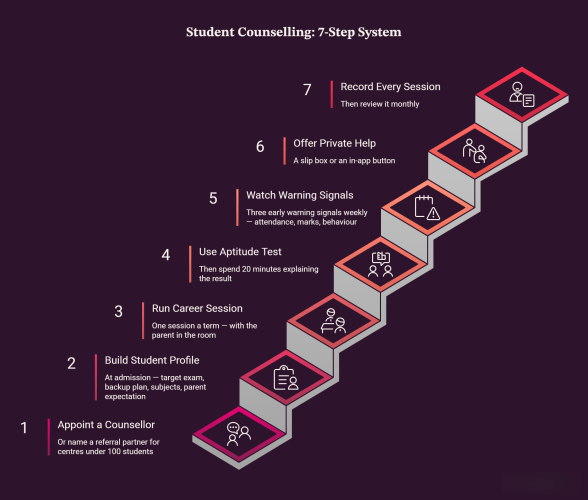
1. Appoint a counsellor, or name a referral partner
Decide who holds this job, by name. Centres with 100 or more students need a qualified counsellor on record. Smaller centres can sign a referral letter with a local psychologist. Put that name and number on your notice board this week.
- Check the counsellor’s training in child and adolescent mental health.
- Agree a fixed weekly slot, even if it runs only two hours.
- Share the referral contact with every class teacher.
- Tell parents who the counsellor is, during admission itself.
2. Build a student profile at admission
Collect the counselling basics while the parent still sits in front of you. Ask about the target exam, the backup option and the subjects the student enjoys. File it with the admission form, never in a teacher’s diary. Your enquiry and admission records can hold these fields from day one.
- Target exam or stream, in the student’s own words.
- Backup plan, since only 22% of Indian students have one.
- Subjects the student likes, and the ones they dread.
- Parent expectation, written down as the parent says it.
- Travel time, sleep hours and other tuitions.
Keep the profile short. Five fields are enough to start. Our guide to lead management for coaching admissions covers the enquiry side.
3. Run one career counselling session a term, with parents
Hold a structured session every term, and invite the parent. The Supreme Court guideline asks for exactly this pairing. Parents push hardest when they know least about the options. One honest hour with both of them removes months of friction.
- Open with the student’s own interests, not the rank.
- Show three real paths, with fees and entry routes.
- Name the trade-offs plainly, such as a drop year.
- Send a short written summary to the parent afterwards.
- Use reminders and notifications so nobody misses the slot.
4. Use an aptitude test, then explain the result
An aptitude or interest test gives the conversation a starting point. It is not a verdict. Pick one standard instrument, then sit with the student to read it. The explanation matters far more than the score.
- Run the test once a year, in Class 9, 10 or 11.
- Spend 20 minutes walking the student through the report.
- Share the same report with the parent on your student and parent app.
- Never use the result to move a student between batches.
5. Watch three early warning signals every week
Most students signal trouble long before they speak about it. Three signals sit in data you already collect. Review them every Monday with your class teachers. A ten minute review catches most cases early.
- Attendance: Two missed classes in one week, visible in biometric attendance.
- Marks: A sharp fall across two tests in your student performance records.
- Behaviour: Withdrawal, irritability or a sudden change of friends.
Act on the signal in the same week. A phone call from the counsellor costs you nothing. Waiting a month can cost you the student.
6. Give students a private way to ask for help
Students rarely walk up to the front desk and ask for a counsellor. Give them a route nobody can watch. A locked request box still works in 2026. A simple form inside the student app works better.
- Keep a request slip box away from the main desk.
- Add a one tap request button in the student app.
- Reply within 24 hours, every single time.
- Keep each request confidential from other students.
7. Record every session, then review it monthly
Write down what happened in each session, in three lines. The Court asks for anonymised records and an annual report. Your monthly review turns those records into decisions. Pull it from your institute reports, beside marks and attendance.
- Date, student code, counsellor, topic and next step.
- Flag every referral to an outside professional.
- Count sessions per batch, so no batch gets skipped.
- Review repeat cases with the batch teacher each month.
Parent feedback closes the loop. Ask parents once a term, not once a year. Our post on running an NPS survey for coaching classes shows a simple way.
Mistakes coaching institutes make with counselling
Most of these mistakes come from good intentions, not neglect. Centres treat counselling as an event rather than a system. Fix these six and the rest gets much easier.
- One session a year is not a system: Most centres run a single talk before board exams.
- Admission staff are not career counsellors: Their target is enrolment, so the advice bends.
- Score based batch names cause harm: The Supreme Court asks you to drop public shaming.
- Parent only meetings miss the point: The student needs one private conversation too.
- No record means no pattern: You will miss the student who asked for help twice.
- Promised outcomes break trust: You control the guidance, never the result.
Career, personal and academic counselling: What is the difference?
Three kinds of counselling solve three different problems. Mixing them is why counselling often feels vague to parents. Give each one its own owner, slot and record. Your teachers can run academic counselling, but not the other two.
| Type | Problem it solves | Who runs it | How often |
|---|---|---|---|
| Career counselling | The student does not know the options after Class 12 | Qualified counsellor, with the parent present | Once a term |
| Personal counselling | Stress, anxiety, family pressure or a sudden change in behaviour | Qualified counsellor or psychologist, alone with the student | On request, plus any flagged case |
| Academic counselling | Weak topics, poor test strategy, low study hours | Class teacher or batch mentor | Every month |
Keep the three records separate. A student may want personal counselling without the batch teacher knowing.
Keep the three records separate. A student may want personal counselling without the batch teacher knowing. Protect that privacy, or the service goes unused.
How software keeps counselling from becoming extra admin
Counselling fails when it adds a second set of registers. Your coaching software already holds attendance, marks and parent contacts. Pull the counselling routine into that same record. Then your weekly review takes ten minutes instead of an afternoon.
- Attendance flags the quiet student first: Biometric attendance shows the pattern before a teacher notices it.
- Test trends show the real slide: Student performance reports compare two tests in one view.
- Parents stay informed without extra calls: Notifications and reminders carry session invites and summaries.
- Students get a private channel: The student and parent app can hold a help request button.
- Owners see the whole picture monthly: Institute reports turn session counts into a review.
None of this needs new software if yours already does the basics. Our post on the features a coaching class should look for covers the rest of the stack. Check your current tool against that list first.
Start with one session this month
Pick one batch and run a single career counselling session this month. Invite the parents. Write down what came up in five lines. You will learn more about your retention risk in that hour than in a term of tests. Then build the other six steps around what you find.
Mentoring compounds slowly. Classpro keeps attendance, marks, parent messages and reports in one place. Counselling then fits into work you already do. Start a free trial and set up your first review. You can also compare plans and pricing before you decide.
Habits like this compound. One centre has proved it over three decades. Read how Mensa Commerce Classes built 32 years of growth.
FAQs
Is student counselling in coaching institutes mandatory in India?
Yes, it is binding today. The Supreme Court issued 15 directions on 25 July 2025 in Sukdeb Saha v. State of Andhra Pradesh. They apply to coaching institutes, training centres and hostels across India. Guideline 12 asks every such institute to run regular career counselling for students and parents. So treat it as a compliance item in your annual plan.
Who can act as a counsellor in a coaching centre?
A qualified counsellor, psychologist or social worker can hold the role. The Court asks for demonstrable training in child and adolescent mental health. Centres below 100 students can instead set up a written referral link. Keep that person’s name, number and agreement on file.
How often should a coaching institute run career counselling?
Run one structured career session per term for each batch, with parents invited. Add personal counselling slots on request through the year. Raise the frequency during board and entrance exam months. In our experience, three touchpoints a year is the point where parents start noticing.
Can class teachers handle counselling instead of a counsellor?
Teachers can handle academic counselling, such as weak topics and test strategy. They should not handle personal counselling or career decisions alone. A teacher who grades the student cannot also be a confidential listener. Keep the two roles separate, and your students will actually use the service.
What should a counselling session record contain?
Keep it to five fields: Date, student code, counsellor, topic and next step. Mark any referral to an outside professional. Store it with anonymised codes rather than names where you can. That record is also what your annual report to the regulator needs.
How do I know whether counselling is working?
Track four numbers each term, and compare them with the term before. Watch batch wise dropout, mid term withdrawal requests, parent complaint volume and renewal rate. Also count how many students request a session themselves. A rising self request count is the clearest sign that students trust the service.
Sources
Mental health of young adults pursuing higher education in Tier-1 cities of India, Asian Journal of Psychiatry, April 2025. A survey of 1,628 Indian students aged 18 to 29, across eight Tier 1 cities.
Only 10% of Indian students receive career guidance: Study, Deccan Herald, September 2025. A United Nations backed survey of 21,239 students in Classes 9 to 12, across 14 districts in seven Indian states.
Supreme Court guidelines on protecting the mental health of students in coaching centres and colleges, SCC Online, 25 July 2025. The full text of the 15 directions in Sukdeb Saha v. State of Andhra Pradesh.