



You rent a hall. You hire two teachers. You print pamphlets outside the nearest commerce college. Then three similar commerce coaching classes open on the same road within a year.
Most of them close before their third batch finishes. Prof. Narayan S. Iyer and Prof. Shiva Muthuswamy did not. They started Mensa Commerce Classes in June 1994, and they still run it in 2026. This post shares nine lessons from their 32 years, in their own words.
Commerce coaching classes: The quick answer
Commerce coaching classes last when the owner has practised the subject, not only studied it. The two founders here were a Chartered Accountant and a Cost Accountant. They taught above the exam level, hired teachers slowly, and let student results bring the next batch. They also spent two to three years building the name before growth arrived.
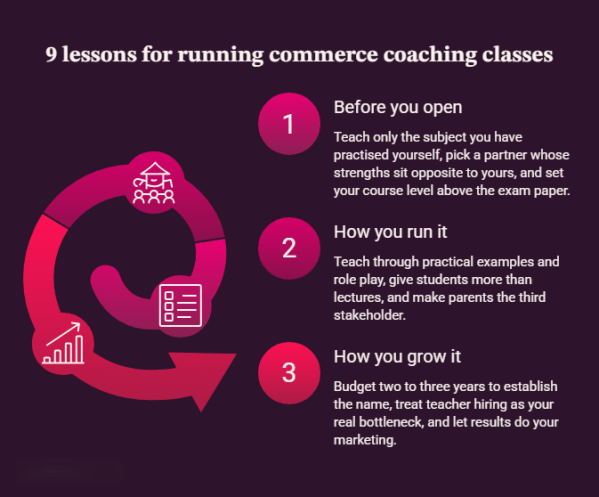
Here are the nine lessons in short:
- Teach only the subject you have practised yourself.
- Pick a partner whose strengths sit opposite to yours.
- Set your course level above the exam paper.
- Teach through practical examples and role play.
- Give students more than lectures.
- Make parents the third stakeholder, not an audience.
- Budget two to three years to establish the name.
- Treat teacher hiring as your real bottleneck.
- Let results do your marketing.
Why commerce coaching classes are harder to run in 2026
Commerce coaching classes now face bigger demand and sharper scrutiny than they did in 1994. Three numbers show the shift. Each one changes how you should plan your first three years.
The money grew. IMARC Group values India’s coaching institutes market at USD 8.1 billion in 2026. The 2025 figure was USD 7.2 billion. So more owners will open a commerce coaching institute near you this year.
The exams stayed brutal. ICAI declared the CA Intermediate September 2026 results on 22 October 2026. Only 23.14% cleared Group I. Just 13.21% cleared both groups together. Parents choosing CA coaching classes read those numbers before they read your pamphlet.
The regulator started watching. In May 2026 the Ministry of Consumer Affairs gave an update on coaching advertisements. The CCPA had issued more than 60 notices to coaching institutes. Penalties crossed ₹1.46 crore. So your result claims now need proof behind them.
Who are the founders behind these lessons?
Prof. Narayan S. Iyer is a Chartered Accountant. Prof. Shiva Muthuswamy is a Cost Accountant. A common friend introduced them in June 1994 because both loved teaching commerce students.
“We spoke for just 10 minutes,” says Prof. Iyer. “It was clearly evident that we wanted to partner together,” he adds. Prof. Iyer had spent more than 11 years in the corporate world. He qualified as a CA alongside that job.
Prof. Shiva took a different route into the same work altogether. He cleared his Cost Accountancy in 1992, in the shortest possible time. He then moved straight into teaching rather than into a corporate role.
Before you open your commerce coaching classes
The first three decisions shape the next three decades. Make them before you sign a rent agreement. Each one costs you nothing today and saves you years later.
1. Teach only the subject you have practised yourself
Pick the subject you have already worked in, not the subject with the most students. Prof. Iyer and Prof. Shiva chose commerce for a plain reason. Both had already earned a professional qualification in the field.
“We thought we should follow our strong suit,” says Prof. Iyer. So they could teach from practice rather than from a textbook. Students notice that difference in the first week. Parents hear about it by the end of the first month.
2. Pick a partner whose strengths sit opposite to yours
Two owners with the same background duplicate each other. Two owners with different backgrounds cover more ground. That gap decides how much of the work you can split.
Prof. Iyer brought corporate experience from a large paint company. Prof. Shiva brought pure teaching experience from school tuition classes. “We both are two extremes working together,” says Prof. Iyer. That contrast kept the partnership useful for 32 years.
3. Set your course level above the exam paper
Teach one level higher than the paper your students will write. Mensa built a graduate-level course structure for junior college commerce students. The students then found their actual exam easier than their classes.
That gap creates the result gap parents talk about later. It also protects you when a board changes its paper pattern. Your students stay ready either way. Few new commerce coaching classes plan for that.
How to run commerce coaching classes students stay with
Teaching quality keeps students. Facilities and communication keep their parents calm. You need both, and most owners build only the first.
4. Teach through practical examples and role play
Commerce concepts stick when students see them happen, not when they read them. Mensa teaches with what Prof. Iyer calls the virtue of experience. Teachers bring in real cases and link new topics to what students already know.
Some faculty run skits, where students act out a business situation through role play. The class then discusses how to handle it. Students remember the scene long after they forget the definition.
5. Give students more than lectures
Lectures end at 10:30 in the morning for junior college students at Mensa. The institute gives them reasons to stay on after that. Students get a separate room to rest and eat, plus a library on the premises.
They can walk up to any faculty member and ask doubts without an appointment. Mensa also recorded 10 to 15 minute videos so students can revise a concept they missed. You can share that kind of material through homework and assignment tools. A WhatsApp group just scrolls away.
6. Make parents the third stakeholder, not an audience
Parents fund the fees, so treat them as part of the team. Mensa runs this as a triangle of student, teacher and parent. “Blaming anyone doesn’t help,” the founders say.
They hold regular parent-teacher meetings and career guidance meets face to face. Between those meetings, parents see attendance and marks through Classpro. A student and parent app with automatic reminders does that quiet work daily. No parent then waits three months for a report card.
How to grow commerce coaching classes without an ad budget
Mensa grew before social media and before Google Ads existed. Three habits did the work. All three still work for a commerce coaching business today.
7. Budget two to three years to establish the name
New commerce coaching classes do not beat the market leader in one admission cycle. Plan your cash for a slower climb. The founders describe going beyond 100% during that stretch.
“One big hurdle was how to penetrate and face the market leaders,” says Prof. Iyer. Mensa needed roughly two to three years to establish itself as a brand. If your plan assumes profit in year one, rebuild the plan.
8. Treat teacher hiring as your real bottleneck
Good faculty, not students, will be your scarce resource. Mensa once travelled all the way to Chennai to hire teachers for its Mumbai classes. That problem has flipped since.
Mumbai now has plenty of qualified CAs who want to teach. “Judging the talent and teaching potential is the challenge,” says Prof. Iyer. So build a trial-class step into your hiring. Watch a candidate handle a live doubt before you sign them.
9. Let results do your marketing
Mensa had no advanced marketing channels in 1994 and still got ranks from its first year. Word of mouth carried the rest. “Content indeed was the king,” says Prof. Iyer, pointing to teaching material and classroom discipline.
Within four to five years, many of their students qualified and took well-paid corporate jobs. Other parents saw those outcomes and compared. Tracking student performance batch by batch gives you that proof in a form you can show. Our guide to SEO and Google Ads for coaching institutes covers the basics. For the wider playbook, read how to increase students in coaching.
Commerce coaching classes: Then and now
The founders have watched the job change since 1994. This table sums up what moved. Use it to check which part of your own setup still sits in 1994.
Commerce coaching classes: then and now
What changed between 1994 and 2026
| What changed | How it worked in 1994 | How it works in 2026 |
|---|---|---|
| Teaching tools | Chalkboards and printed notes | Slides, recorded revision videos, shared files |
| Finding faculty | Travel to another city to hire | Qualified CAs available locally, screening is the hard part |
| Reaching parents | Printed report cards and meetings | Live attendance and marks, plus meetings |
| Study material | Handed out in class only | Shared online within minutes |
| Proof parents want | Word of mouth from other parents | Published results, with honest disclosure under CCPA rules |
“From chalkboards to powerpoint presentations we have definitely grown technologically,” says Prof. Iyer. The time lag to find an answer or a material has dropped. So the excuse for a weak class has dropped too.
Mistakes to avoid when you start commerce coaching classes
Most new commerce coaching classes lose students to admin gaps, not to teaching gaps. Watch these five. Each one shows up in the first two admission cycles.
- Chasing every commerce stream at once. Pick one exam or one board first, then add the next.
- Letting enquiries sit for a day. Parents enquire at three centres on the same evening, so track every lead in one place.
- Running fees on a notebook. Missed instalments quietly fund your competitor, so keep fee reminders automatic.
- Advertising results without disclosure. CCPA penalties in 2026 hit institutes that showed toppers without naming the course taken.
- Hiring fast in admission season. One weak teacher costs you a whole batch of word of mouth.
The last point costs the most and shows up the least. Our post on how to increase admissions in a coaching institute covers follow-up habits in detail. Fix that habit before you raise your ad budget.
Run your commerce coaching classes with less paperwork
The founders of Mensa built their name on teaching. They handed attendance, marks and parent updates to software. That is the trade worth making, because your hours belong in the classroom.
Classpro runs admissions, batches, attendance, fees, parent updates and reports from one place. Start a free trial of Classpro and set up your first batch today. You can also compare plans and pricing. Before you decide, read our guide to the best coaching institute management software.
FAQs
How to start commerce coaching classes in India?
Start with the commerce subject you have practised, such as accountancy, costing or taxation. Register your business and check your state coaching rules. Then fix one batch, one timing and one fee before you add a second subject. Mensa began with two founders, one shared passion and a graduate-level course structure.
Do I need to be a CA to run commerce coaching classes?
No rule forces the owner to hold a CA qualification. Both Mensa founders held professional qualifications, and that credibility helped them from day one. If you do not hold one, hire faculty who do. Then say so plainly in your material.
How long does a commerce coaching institute take to establish a brand?
Mensa needed around two to three years to establish itself against the market leaders of that time. In our experience, most new institutes see steady referral admissions from year three. Plan your working capital for that stretch rather than for a quick payback.
How do commerce coaching classes compete with online courses?
The Mensa founders treat it as a mix rather than a contest. Classroom teaching lets a teacher read body language, cut distractions and hold a routine. Online lessons suit revision and missed topics. A hybrid of both, in their view, gives higher productivity.
How do commerce coaching classes keep parents informed?
Share attendance and marks as they happen, then meet face to face for the bigger picture. Mensa uses Classpro for daily updates and keeps parent-teacher meetings for context. Insightful reports also let you show a parent a trend instead of one test score.
What is the biggest mistake new commerce coaching classes make?
New owners usually spend on marketing before they fix follow-up. Enquiries arrive, nobody calls back within a day, and the parent joins another centre. Fix the follow-up habit first, because it converts leads you have already paid for.





1 Comment
Mensa is the registered trade name of Mensa International in India and abroad. ClassPro is using this trade name illegally without any approval from Mensa International or Mensa India. ClassPro has no affiliation with Mensa in any form and should remove this name from its title immediately.
Kishore Asthana
President, Mensa India