



It is 9 am on a Sunday. Forty students sit in your hall with question papers. Your team promoted this test for six weeks. By Tuesday, four students have joined your batch. The rest stop answering your calls.
That outcome is normal, and you can fix it. A coaching scholarship test brings the right students through your door. Filling the batch takes seven decisions, not one good exam. This guide walks through each one.
Coaching scholarship test: The quick answer
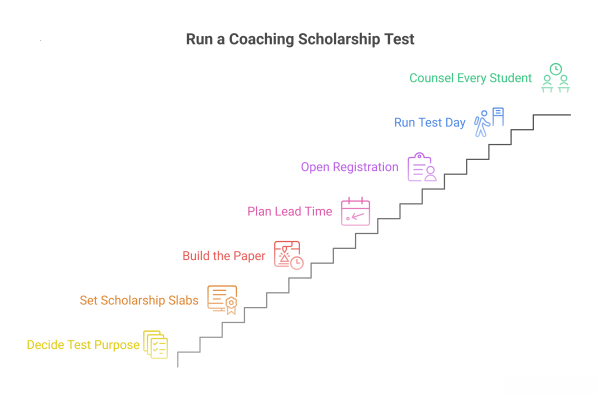
The test fills batches when you follow seven steps in order:
- Decide what the test is for before you fix a date.
- Set scholarship slabs your fee structure can absorb.
- Build a paper that separates students without scaring them.
- Work backwards from your batch start date.
- Make registration take two minutes.
- Run test day like a real exam.
- Counsel every student who sat the test, not only the toppers.
Most institutes do the first six well. Step seven is where the batch actually fills. Skip it and you hand your best leads to a competitor.
Why a coaching scholarship test beats a flat discount
Fee pressure on Indian families keeps climbing. The government surveyed 52,085 households between April and June 2025. That Comprehensive Modular Survey on Education found 27% of students take private coaching. Urban families spend ₹3,988 a year per student on it.
Almost none of those families get outside help. The same 2025 survey found 95% of students fund schooling from household money. Only 1.2% named a government scholarship as their main source. So your scholarship is often the only fee relief a family will ever see.
Your competitors have noticed. IMARC Group values the India coaching institutes market at USD 8.1 billion in 2026. That is up from USD 7.2 billion in 2025. More institutes mean more scholarship posters in every parent’s phone.
A test beats a flat discount for three reasons:
- A discount lowers your price for everyone. A test lowers it only for students who earn it, so your margin survives.
- A test gives you a dated list of warm leads. Every registration is a family actively shopping for coaching this season.
- A test gives your team a reason to call. Results, ranks and slabs are real news, not a sales pitch.
Before the test: Design a scholarship test for your coaching institute
1. Decide what the test is actually for
Pick one goal and build around it. Three goals are common, and they pull in different directions.
- Fill a specific batch: Target one class and one course, then size the test to that batch.
- Build your brand in a new area: Run it in a school or a locality you want to enter.
- Find genuine toppers for your results board: Keep the paper hard and the slabs deep.
Owners get into trouble when they chase all three at once. A hard paper scares away the volume you need to fill seats. A soft paper hands waivers to students who would have paid full fee.
2. Set scholarship slabs your fee structure can absorb
Start from your batch economics, not from a competitor’s poster. Add up faculty salary, rent, materials and admin for one batch. Divide that by your seat count to get a cost per seat. Now you know what a waiver really costs you.
Then set a ceiling. In our experience, capping total waivers at 10% of batch revenue works well. A 40-seat batch at ₹40,000 each earns ₹16 lakh. Your total giveaway stays under ₹1.6 lakh.
Spread that ceiling across slabs instead of one headline number:
- Top 1 or 2 ranks: Full waiver of 100%.
- Next 5 ranks: Half waiver of 50%.
- Next 10 ranks: Quarter waiver of 25%.
- Everyone above the cut-off: A small waiver of 10%.
That last slab does the heavy lifting. It gives every serious student a reason to join on result day. Write each slab into your fee plan before the test. Classpro’s fee management stores the waiver against each student, so your receipts stay clean.
3. Build a paper that separates students without scaring them
A scholarship cum admission test has one job. It must rank students fairly and still feel winnable. Those two goals fight each other when the paper gets too hard.
Keep the syllabus one class below your target batch. Use 25 to 40 objective questions across 60 to 90 minutes. Aim for a top score near 70%, not 95%. Skip negative marking in foundation and school-level tests.
Publish the pattern and one sample paper before registration opens. Students who prepare show up. Students who guess do not.
4. Work backwards from your batch start date
Most owners fix a test date first and the batch date later. Reverse that order. Your batch start date is the only fixed point that matters.
Count backwards from it:
- Six weeks before: Registration opens and promotion starts.
- Two weeks before: Test day.
- One week before: Results, counselling calls and fee collection.
Avoid board exam weeks and school annual days completely. Also plan a second sitting about three weeks later. Students who miss the first date are still live leads. Our month-by-month admissions plan shows where this fits in your year.
Running the test: Registration to result day
5. Make registration take two minutes
Every extra form field costs you registrations. Ask for five things only: Name, class, school, parent mobile number and preferred centre. Everything else can wait until admission.
Keep the form free, or charge a small refundable amount to cut no-shows. Then treat each entry as a lead, not a roll number. Log every registration in one place, such as Classpro’s enquiries and lead management. Our guide on how to increase admissions covers the follow-up rhythm that works.
Promotion decides your volume here. School tie-ups, parent WhatsApp groups and local ads all work. Our post on how to promote coaching classes lists the channels worth your money.
6. Run test day like a real exam
A coaching scholarship test is often a family’s first visit to your centre. Parents judge your whole institute on this one morning. A messy hall costs you admissions you already earned. So run it properly.
Send one reminder the evening before with the time, address and roll number. Print hall tickets and seat students by number. Start on time, even if some families arrive late. Automated reminders handle the messaging without anyone tracking it manually.
Then use the waiting parents well. Put them in a separate room with tea and a 20-minute session. Show your results, your faculty and your batch timings. That window is your best selling slot of the whole season.
After the test: Where batches actually get filled
7. Counsel every student, not only the toppers
Here is where most institutes lose the batch. They call the top five ranks and post the merit list online. The other 90% hear nothing and join somewhere else.
Declare results within 72 hours while the test still feels fresh. Then call every student in rank order, starting from the top. Give each family three specific things:
- The rank and the score: Say where the student stands and what they did well.
- The slab they earned: Name the exact fee after the waiver, in rupees.
- The batch start date: Give a real seat deadline you will actually honour.
Share a proper scorecard rather than a rank alone. Student performance reports let you show topic-wise gaps in the counselling meeting. That conversation sells your teaching better than any brochure. Our guide on student counselling in coaching institutes covers the script in detail.
Keep the parent in the loop after they join. A parent app with scores and attendance answers the question every family asks silently. Informed parents renew faster and refer more students.
Scholarship test or free demo class: Which fills batches faster?
Both tools work, and they suit different moments in your admission cycle.
| Factor | Scholarship test | Free demo class |
|---|---|---|
| Leads per event | 40 to 300 at once | 1 to 10 per week |
| Lead quality | Mixed, needs sorting | High, already interested |
| Effort to run | High, one big day | Low, ongoing |
| Time to decision | 7 to 10 days | 2 to 3 days |
| Best used for | New batch launch, new area | Steady enquiry flow |
| Main risk | Giving away margin | Low volume |
Run a scholarship test to launch a batch or enter a new locality. Run demos all year to convert the enquiries that trickle in. Our guide on turning a demo class into an admission covers that second track.
Five mistakes that turn your scholarship test into a discount sale
These errors show up at institute after institute. Each one quietly costs you money or admissions.
- Advertising “up to 100% scholarship” with two seats behind it. Families compare notes, and the gap damages your name locally.
- Setting slabs after the results arrive. You will stretch the numbers for a good student and break your own budget.
- Making the paper too hard. A low top score makes every slab look unreachable and kills your conversion.
- Calling only the merit list. The students ranked 20 to 100 are your actual batch.
- Forgetting the conditions in writing. Attendance rules and fee deadlines must sit in the offer letter, not in a phone call.
Students have also grown smarter about this. Many now sit three or four tests and pick the deepest slab. So compete on teaching and proof, not only on the waiver percentage.
Four numbers to track after every scholarship test
Measure these four and your weak step becomes obvious. Review them within a week of every coaching scholarship test.
- Registrations: Count completed forms. A low number points at promotion, not at the test.
- Show-up rate: Divide attendees by registrations. Below 60% means your reminders failed.
- Conversion rate: Divide admissions by attendees. This is your real scholarship test performance.
- Average waiver given: Divide total waiver value by admissions. Rising numbers mean your slabs need tightening.
Track these for every sitting and compare across seasons. One weak number usually explains the whole result. Classpro’s reports pull these figures without manual counting.
Make your next coaching scholarship test fill the batch
A scholarship test for coaching institutes is not a discount scheme. It is a sorting tool that hands you a batch worth of warm leads in one morning. Design the slabs first, run the day properly, then call every single student.
Start with one change this season. Count your conversion rate from the last test you ran. Then fix whichever of the seven steps looks weakest.
Classpro helps coaching institutes track every registration through to a paid admission. Start your free trial and see where your scholarship test leaks. You can also compare plans and pricing for your institute.
FAQs
What is a coaching scholarship test?
A coaching scholarship test is an exam an institute runs to award fee waivers. Students sit a short objective paper and get ranked. Top ranks receive a bigger discount on the course fee. Institutes use it to attract strong students and fill new batches.
How to conduct a scholarship test in a coaching institute?
Fix your batch start date, then count backwards six weeks. Open registration, publish the pattern, and run the paper two weeks before the batch begins. Declare results within 72 hours. Then counsel every student who appeared, in rank order. A coaching scholarship test works only if the batch starts soon after.
How much scholarship should a coaching institute offer?
Cap your total waivers at about 10% of batch revenue. Spread that across four slabs instead of one headline figure. Reserve the 100% waiver for one or two ranks only. Give every student above a cut-off a small waiver so they have a reason to join.
What is a scholarship cum admission test?
A scholarship cum admission test does two jobs in one paper. It decides who gets a fee waiver and who qualifies for the batch. Large institutes run one scholarship test for admission and fee waiver together. Smaller institutes usually keep admission open to everyone who appears.
How many questions should a scholarship test have?
Use 25 to 40 objective questions across 60 to 90 minutes. Keep the syllabus one class below your target batch. Aim for a top score near 70%, which keeps the slabs believable. Skip negative marking for school and foundation level tests.
Scholarship test ke baad students ko follow up kaise karein?
Call every student within 72 hours of the result, in rank order. Share the rank, the exact fee after waiver, and the batch start date. Send the same details on WhatsApp so parents can read them later. Follow up twice more before your seat deadline closes.