

Key takeaways
- Most parent objections hide a different worry. Ask one question before you answer anything.
- Never drop your fee first. Split it into monthly instalments and keep the value intact.
- Parents compare you with two or three nearby institutes. Name the difference yourself, clearly.
- Proof beats promises. One current parent’s phone number works better than ten topper photos.
- Book the next step before the parent leaves. A vague “we will think” rarely comes back.
Why parents object during coaching admissions
A father sits across your counsellor’s desk at 7 pm. He likes the faculty and the timings. Then he hears the fee. He says he will discuss it at home and call back. He never calls.
That single conversation just cost you a full year of fees. It also cost you the referrals that family would have sent. Most institutes blame the fee. The real problem sits in the reply your counsellor gave.
Parents today are not rejecting coaching. The Ministry of Statistics and Programme Implementation found something clear in its 2025 education survey. Its Comprehensive Modular Survey: Education, 2025 covered 52,085 households. About 27% of Indian students took private coaching that year. In urban India the figure reached 30.7%.
So parents already believe in coaching. They just have more institutes to pick from. IMARC’s India coaching institutes report, updated in October 2026, sizes the market at USD 8.1 billion. In 2025 it stood at USD 7.2 billion.
Every objection you hear is really a comparison with someone else. Most of that comparing happens on Google first. Our guide on SEO and Google Ads for coaching institutes shows how parents search.
Two more things changed recently. Safety is now a live parent question. In June 2026, Uttar Pradesh sealed twelve coaching centres in Lucknow after a fire killed 15 people. More than 100 institutes across the state came under scrutiny.
Fee terms moved into law too. The Rajasthan Assembly passed its coaching centres regulation Bill on 3 September 2025. It bars any fee increase during a course. It also requires refunds for unused classes.
Parents read this news. They walk in cautious and well prepared. Learning how to convince parents for admission now means answering harder questions. Your counsellors need better replies than they used five years ago.
The 4-step method behind every good reply
Every script below rests on the same four steps. Teach the method first. Then the words come easily.
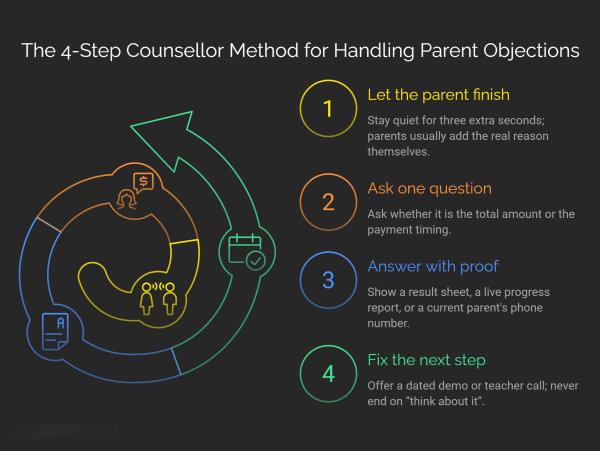
Let the parent finish
Counsellors interrupt too early. The parent says “the fee is high” and the counsellor jumps to instalments. Stay quiet for three more seconds. Parents usually add the real reason themselves.
Ask one question to find the real concern
“The fee is high” can mean five different things. It may mean the total feels large. It may mean the monthly outgo clashes with school fees. It may mean another institute quoted less.
Ask one simple question. “Is it the total amount, or the timing of the payments?” The answer tells you which reply to use. One question saves five minutes of guessing.
Answer with proof, not promises
Promises sound the same at every institute. Proof does not. Show the attendance record of last year’s batch. Share a current parent’s number. Open your app and show a real progress report.
Fix the next step before they leave
Never end on “think about it and let us know.” Offer a dated next step instead. A demo class on Saturday works. A call with the subject teacher on Thursday works too.
9 parent objections and exactly what to say
Use these as a starting script for parent objections. Change the words to match your city and your fee. Say them aloud once before you use them on a parent.
1. “The fees are too high”
The fee objection tops every list, in every city. Parents rarely compare your fee with zero. They compare it with another quote. First ask whether the issue is the total or the monthly outgo.
Then say this. “I understand. Let me show you what the fee covers, and then we can look at payment options.” Walk through the hours, the tests, the study material and the doubt sessions. Divide the fee by the number of teaching hours.
Only after that, offer instalments. Classpro’s fee management lets you set a monthly plan and share a receipt on the spot. Written terms calm parents more than a discount does.
2. “We will think about it and let you know”
This is the most common objection, and the most ignored. It usually means one person is not convinced yet. Often that person is not even in the room.
Say this. “Of course. Is it something about the course, or do you want to discuss it with someone at home?” If they mention a spouse, offer a short call with both. Then book the next step before they stand up.
3. “The class near our house is cheaper”
Never criticise the other institute. Parents hear that as insecurity. Compare on things they can verify instead.
Say this. “They are a good option. May I show you three things to compare on both sides?” Then name batch size, teacher availability and test frequency. Let the parent do the maths themselves.
4. “My child’s friends joined another institute”
This objection comes from the student, and the parent repeats it. Acknowledge it honestly. Friendship matters at fifteen.
Say this. “That is fair. Would it help if he attends one demo with us before deciding?” A demo class breaks the friend logic faster than any argument. Many institutes also run a friends-join-together offer, which works well here.
5. “Your batch size is too big”
Parents fear their child will disappear in the crowd. Numbers alone will not fix this. Show them your system for tracking individuals.
Say this. “We keep 40 per batch, and here is how we track every student weekly.” Then open a real student report. Our student performance tracking shows test-wise progress for each child, which answers that fear directly.
6. “We want to meet the teacher first”
Say yes immediately. Hesitation here looks like you are hiding something. Most institutes lose this one by asking the parent to come back later.
Say this. “Absolutely. Sir is free at 7.30 today, or Saturday at 11. Which suits you?” Give two slots, not an open invite. A named teacher and a fixed time beat any brochure.
7. “The batch timing does not suit us”
Check whether the problem is travel or the clash with school. The two need different answers. Ask before you offer anything.
Say this. “Let me check two other batches for you. Does 6 pm on weekdays work, or would weekends suit better?” If nothing fits, offer a recorded session or a weekend doubt slot. Honest flexibility beats a forced yes.
8. “How do we know your results are real?”
Fair question, and a growing one. Vague claims hurt you now. Parents have seen too many inflated banners.
Say this. “Here are last year’s results with roll numbers, and two parents you can call today.” Nothing converts like a parent who speaks to another parent. Keep three willing families on a ready list.
9. “Last year’s coaching did nothing for my child”
This parent is not objecting to you. They carry a bad experience. Let them describe it fully before you reply.
Say this. “That sounds frustrating. May I show you how we track progress here?” Then open your weekly update system. Regular parent notifications on attendance and marks answer that fear directly. Parents stop guessing what happens in class.
What counsellors should never say
These five habits lose admissions quietly. Most counsellors pick them up by copying a senior. Fix them in your next team meeting.
- Discounting within the first two minutes. It tells the parent you padded the fee all along.
- Criticising the competitor by name. Parents repeat your words to that institute, and your reputation travels.
- Promising ranks or guaranteed marks. Several state rules now treat rank guarantees as misleading claims.
- Talking only to the student. The parent signs the cheque and needs the reassurance.
- Ending with “think about it.” A conversation without a next date almost never restarts.
Objection to reply: A quick reference table
Parent objections and your first line
Print this and stick it near the counselling desk.
| Parent says | What it usually means | Your first line |
|---|---|---|
| The fees are too high | Monthly outgo worries them | “Is it the total, or the payment timing?” |
| We will think about it | Someone at home is not convinced | “Would you like a quick call with both of you?” |
| The nearby class is cheaper | They want a reason to pay more | “May I show you three things to compare?” |
| His friends joined elsewhere | The student decided, not the parent | “Would one demo class help him decide?” |
| Your batch is too big | They fear no personal attention | “Here is how we track every student weekly.” |
| We want to meet the teacher | They doubt the faculty quality | “Sir is free at 7.30 or Saturday. Which suits?” |
| Timing does not suit | Travel or school clash | “Let me check two other batches for you.” |
| Are your results real | Past claims burned them | “Here are two parents you can call today.” |
| Last coaching failed us | They fear a repeat | “May I show you how we track progress?” |
Ask the question first. Answer second.
The 48-hour follow-up that converts undecided parents
Most admissions die after the parent leaves, not during the conversation. In our experience, the first two days decide the outcome. Build a fixed routine and stop relying on memory.
Here is a follow-up routine that works for coaching admissions.
- Within 2 hours: Send a WhatsApp with the fee breakup and the demo slot in writing.
- Day 1 evening: The counsellor calls once, briefly, and answers any new question.
- Day 2: Share one proof item, such as a result sheet or a parent testimonial.
- Day 4: Offer a final dated option, then move the lead to a nurture list.
Every objection the parent raised should sit in your records. Classpro’s enquiry and lead management logs the objection, the owner and the next follow-up date. Owners can then see which objection kills the most admissions through the reports dashboard.
Also fix the stage before this one. Many institutes lose parents long before counselling, as our guide on how parents discover coaching centres explains. If your enquiries themselves are thin, start with increasing leads for your coaching institute.
Three drills to train your counselling team
Scripts fade without practice. Run these admission counselling drills every month. Each one takes under 30 minutes.
The objection round
Write the nine objections on slips. Each counsellor picks one and replies in 60 seconds. The team scores the reply on one point only. Did they ask a question before answering?
The recording review
Record three real counselling calls each week, with consent. Play one in the team meeting. Stop at the first objection and ask everyone what they would say next.
The proof audit
Ask each counsellor to show their proof kit. It needs three items. Last year’s results, two parent references and one live student report from the parent app.
How to convince parents for admission with a system, not a pitch
Parent objections are not rejections. They are the parent’s way of asking for more information. Counsellors who ask one question before answering will convert far more of them. Counsellors who follow up on a fixed schedule will convert the rest.
The script matters. The system behind it matters more. That is how to convince parents for admission month after month.
Log every objection and assign every follow-up. Let parents see real progress once the child joins. Attendance alerts through biometric attendance and weekly parent updates keep that trust alive after admission. Institutes that get this right also grow faster overall. We covered the wider playbook in proven ways to get more students.
Want to see how your counsellors handle parent objections this season? Start your free Classpro trial and track every enquiry from first call to admission. You can also check our plans and pricing to find the right fit for your institute.
FAQs
How to convince parents for admission without reducing the fee?
Break the fee into value first, then into instalments. Show the teaching hours, tests and doubt sessions it covers. Offer a monthly plan with a written receipt. A discount lowers your worth, while a payment plan protects it.
What should a counsellor say when parents say they will think about it?
Ask one gentle question. “Is it about the course, or do you want to discuss it at home?” Then fix a dated next step before they leave. An open-ended wait almost always goes cold.
How many follow-ups should a counsellor do after a counselling session?
Four touchpoints over four days work well for coaching institutes. Send written details within two hours, call on day one and share proof on day two. Offer one final dated option on day four. After that, move the lead to a nurture list.
Should counsellors speak to the parent or the student first?
Speak to both, but address the parent for fees, safety and progress tracking. Address the student for batch timings, friends and teaching style. Ignoring either one costs you the admission.
What is the biggest mistake during admission counselling?
Answering before understanding the real concern. Counsellors hear a fee objection and immediately offer a discount. The parent may have meant the payment timing instead. One question first saves both the margin and the admission.
Do parents really ask about safety now?
Yes, and far more than before. After the June 2026 Lucknow fire, Uttar Pradesh sealed twelve coaching centres. Officials checked more than 100 others. Keep your fire NOC, exits and occupancy details ready to show.