


Key takeaways
- Take written consent after the result, never at admission time. The CCPA guidelines allow no other order.
- Print the exact course each student took. Hiding that a topper joined only a test series is the most common finding in CCPA orders.
- Keep your disclaimer in the same font size as your claim. Small print at the bottom of a hoarding fails.
- CBSE declares no topper list. So “CBSE topper” is a claim nobody can verify for you.
- Under-18 toppers need a parent signature too. India’s data rules make that a duty, not a courtesy.
The result comes out at 10 in the morning. By noon, your designer sends the first hoarding draft. By evening, the banner goes up near the market. Then a parent asks one question you cannot answer: Which batch did that boy actually attend? That gap between banner and batch register is where a topper advertisement becomes a notice.
This guide covers three things. You get the rules in plain language, the consent steps, and a 14-day plan for results season. You also get the exact claims that have already cost Indian institutes money.
Quick answer: What makes a topper advertisement legal in India?
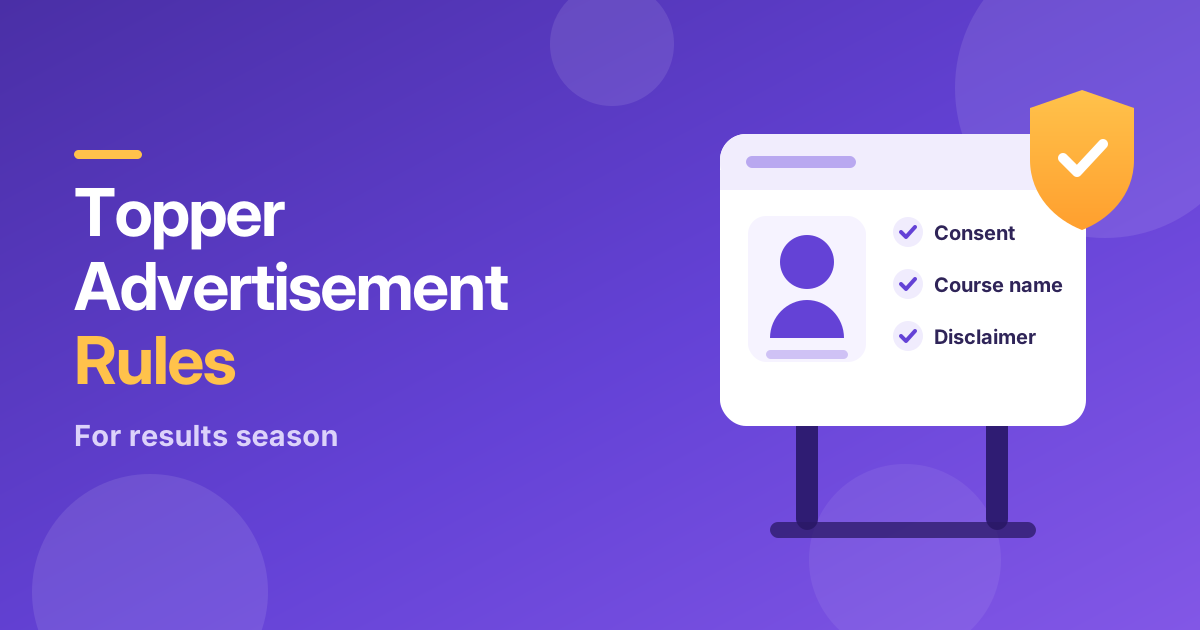
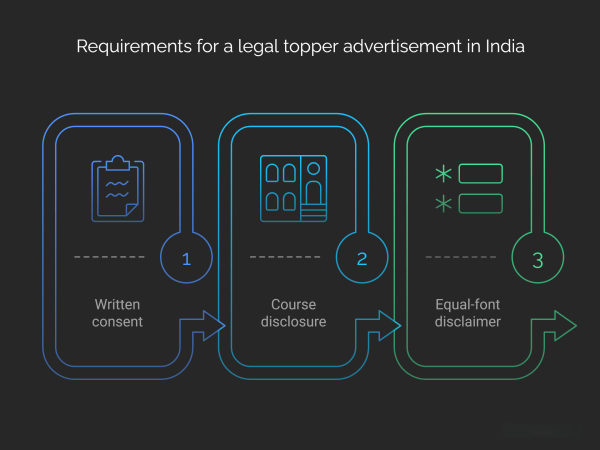
In short: A legal topper advertisement needs three things. You need written consent that you collect after the selection. You need the exact course name beside each photo. And you need a disclaimer in the same font size as your claim. Everything else in this guide builds on those three.
Here is the checklist at a glance:
- Consent after the result: Ask the student in writing, once the result is out.
- Course label: Say whether it was a full-time batch, a crash course, or a test series.
- Provable numbers: Keep the roll numbers, the marksheets, and the batch register.
- Equal font: Set the disclaimer at the same size as the claim it explains.
- Same rules everywhere: Apply all of this to your website, WhatsApp, Instagram, and newspaper ads.
Why results season decides your whole admission year
Results season is short. Board, JEE, and NEET results land within a few weeks of each other. Meanwhile, parents compare institutes in that window, and then they decide. So the hoarding you put up in May often fills your July batches.
The same window carries your biggest legal risk. Every claim you make goes on record, in print and online. The regulator now reads those records without waiting for a complaint.
What CCPA enforcement looks like now
The Central Consumer Protection Authority acts on its own these days. In its orders of 15 May 2026, it fined two coaching institutes ₹10 lakh and ₹5 lakh. By then it had issued more than 60 notices. Also, it had imposed over ₹1.39 crore on 31 institutes.
Two findings repeat across those orders. The institutes used students’ names and photos without proper consent. They also hid the actual course those students had taken. One institute even featured students who joined after the exam.
The authority checked websites, YouTube channels, Instagram accounts, and newspaper advertisements. So a coaching result advertisement faces the same test on every channel. Your reel counts as much as your hoarding.
What the CCPA rules actually say about a topper advertisement
The Guidelines for Prevention of Misleading Advertisement in Coaching Sector, 2024 run to a few pages. Most of it matters to you in four places. Here they are in plain words.
Claims you cannot make
The guidelines list what makes an advertisement misleading. You cannot make false claims about courses, duration, faculty credentials, fees, or refunds. You cannot make false claims about selections, ranks, or success rate. You also cannot promise guaranteed selection, a good rank, or high marks.
One more clause catches many owners. You cannot create a false sense of urgency or false scarcity. So “only 5 seats left” must be true on the day you print it.
What every result claim must disclose
The guidelines ask you to disclose important information beside the candidate’s photograph. That means the rank secured, the name of the course, and its duration. You must also say whether the student paid for that course.
This last point is where institutes slip. A free scholarship batch is not your paid classroom programme. A test series is not a two-year foundation course. Label each one honestly, and the claim becomes safe.
The consent rule most institutes get wrong
You cannot use a student’s name, photo, testimonial, or video without written consent. The guidelines also fix the timing. You must take that consent after the selection, not before.
So the consent clause buried in your admission form does not count. Nor does a WhatsApp reply saying “ok sir”. Get a signed form after the result, and file it. In the May 2026 orders, neither institute could produce such consent.
The disclaimer font rule
Most owners add a disclaimer and assume the job is done. The guidelines set a size rule for it. Your disclaimer font must match the font used in the claim.
So a two-inch headline with six-point small print fails. Tell your designer this before the artwork starts. It changes the layout, so treat it as a brief, not a last-minute fix.
7 topper advertisement rules that still bring admissions
Compliance does not make your creative weak. In our experience, a specific claim sells better than a loud one. These seven rules keep you safe, and they keep you persuasive.
1. Collect written consent after every result
Build this into your result-day routine. Send a consent form to every student you plan to feature. Ask for the name, the rank, the course, and a signature. Then store the signed copy along with the marksheet.
A notification and reminder tool turns this into a five-minute job. Send the form, then chase the few who have not replied. Most students sign the same evening, while they are still celebrating.
2. Name the exact course beside the photo
Print the course name next to each student’s picture. Write “2-year classroom programme”, “6-week crash course”, or “test series only”. Add the duration, and say whether the student paid.
Owners often resist this, because it feels like weakening the claim. In practice it reads as confidence. Parents already distrust a wall of photos, so plain labels help you stand out. Our guide on planning a crash course for board exams shows how to name batches clearly.
3. Use only numbers you can prove on paper
Every number needs a file behind it. If you claim 42 selections, keep 42 marksheets. If you claim a 70% success rate, show the denominator too.
CCPA pulled up one institute for a contradiction. It advertised “1650+” selections, then gave two different periods for the same figure. That single contradiction made the claim unsubstantiated.
A student performance record gives you this evidence without a scramble. Biometric attendance also proves who actually sat in your classroom. Both help a lot if a notice ever arrives.
4. Match the disclaimer to the claim
Set the disclaimer in the same font size as the headline claim. Also, place it near the claim, not at the bottom edge. Keep the wording short, so that size stays workable.
A short, readable disclaimer looks more honest than a long one in tiny print. That helps trust as well as compliance. Our post on coaching institute branding explains why plain claims build a stronger name.
5. Say which rank, and in which list
A rank means little without its list. Write “All India Rank 318, NEET UG” rather than a bare “AIR 318”. Write “school topper” when that is what it is.
CBSE makes this point for you. The board publishes no merit list and no topper list. It issues merit certificates to the top 0.1% in each subject instead. So nobody can verify a “CBSE topper” claim, including you.
6. Keep one evidence file per claim
Open a folder for each result season. Put the signed consent, the marksheet, the batch register entry, and the final artwork inside. Name the folder by exam and year.
If a notice arrives, you face one afternoon of work instead of one month. In our experience, the folder also prevents internal mistakes. Your designer cannot invent a rank when the file sets the text.
7. Apply the rules to every channel
The same rules cover your website, YouTube, Instagram, WhatsApp, and newspaper ads. CCPA examined all of these in the May 2026 cases. Your Instagram reel is an advertisement, and so is your WhatsApp broadcast.
So let one person approve every result creative. Then keep a single approved text file for all channels. Our guide to Instagram marketing for coaching institutes covers the formats that work.
The under-18 problem most coaching ads ignore
Most board toppers are below 18. Many JEE and NEET toppers are too. That changes the consent you need before you publish.
Under India’s data protection framework, a child’s data needs verifiable consent from a parent or guardian. PIB’s note on the DPDP Rules, 2025 sets this out. The Rules allow an eighteen-month phase-in for compliance. The Act also allows very heavy penalties for breaches involving children’s data.
So ask for a parent signature alongside the student’s, starting this season. It costs you one extra line on the form. A student and parent app makes that request easy to send and track.
One caution before you print anything. This post explains the rules, but it is not legal advice. Run a big campaign past a lawyer first.
| Risky claim | Why it fails | Safer version |
|---|---|---|
| “100% selection guaranteed” | The guidelines ban guarantee claims | “42 of our 60 dropper students qualified NEET UG 2026” |
| Topper photo with no course name | It hides the course the student took | Photo plus “2-year classroom programme, paid” |
| “CBSE topper” | CBSE publishes no topper list | “95.6%, Class 12 CBSE, our 2-year batch” |
| “AIR 1” with no list named | It mixes a category rank with the overall rank | “OBC Rank 1, All India Rank 18” |
| Disclaimer in tiny print | The font must match the claim | Disclaimer set in the headline font size |
| Consent taken at admission | Consent must come after the selection | Signed form dated after the result |
Owners often want this table inside their prospectus. Our guide on writing a coaching brochure shows where results belong in one. However, the rules stay the same in print and online.
What to advertise when you have no topper
Most institutes have no state rank, and that is fine. Parents care about their own child, not your best child. So advertise what applies to an average student.
- Improvement numbers: Show how your batch average moved from the first test to the board.
- Retention: Say how many Class 10 students stayed on for Class 11.
- Contact hours: Show the weekly teaching and doubt-solving a student actually gets.
- Parent reviews: Use recent reviews, with names and permission.
- Teacher stability: Say how long your faculty has taught that batch.
Each of these needs the same evidence discipline. A reports dashboard gives you the numbers without manual counting. Our post on how to increase students in coaching classes covers more of these angles.
Your 14-day results season plan
Results season rewards speed, but only when the paperwork keeps pace. Here is the schedule we suggest.
- Day 0: Result day. Collect marksheets and roll numbers from every student who replies.
- Day 1 and 2: Send consent forms, with a parent signature line for minors.
- Day 3: Match every name against your batch register and fee record.
- Day 4 and 5: Write the claim text, with course labels and the disclaimer.
- Day 6: Let one person approve that text for every channel.
- Day 7: Publish the hoarding, the website page, and the social posts together.
- Day 8 to 14: Answer each enquiry within 30 minutes, and log every one.
That last line matters more than the hoarding. A result advertisement brings a spike of calls for about two weeks. An enquiry and lead management system makes sure none of them goes cold.
Mistakes to avoid in a result advertisement
- Reusing last year’s photos: Consent covers one campaign, not every future one.
- Counting one student twice: The same face in two claims reads as two selections.
- Rounding a success rate up: 88.6% is fine, and 90% is a false claim.
- Featuring a student who joined after the exam: CCPA treated that as false attribution.
- Copying a competitor’s format: Many of those formats are already under notice.
Conclusion
A topper advertisement still works in India. It works better when every claim on it survives a parent’s question. Start with consent, course labels, and provable numbers, and the rest follows.
Results season moves fast, so set the system up before the result arrives. Start your free Classpro trial to keep consent, batch records, and enquiries in one place. You can also see Classpro plans and pricing first.
FAQs
Is a topper advertisement legal in India?
Yes. A topper advertisement is legal when you take written consent after the selection. You must also disclose the rank, the course name, its duration, and whether the student paid.
What happens if CCPA finds my result advertisement misleading?
CCPA can order you to stop the advertisement and impose a penalty. In May 2026 it fined two institutes ₹10 lakh and ₹5 lakh. It had issued more than 60 notices to coaching institutes by then.
Do I need consent from parents for a student under 18?
Take both signatures. India’s DPDP Rules call for verifiable consent from a parent before anyone processes a child’s data. The duties phase in over eighteen months, so build the habit now.
Can I say “100% results” in my coaching advertisement?
No. The guidelines treat guaranteed selection and guaranteed rank claims as misleading. Share a real ratio instead, such as 42 qualified out of 60 students.
How do I prove my result claims if someone asks?
Keep one folder per exam, per year. Put the signed consent, the marksheets, the batch register, and the final artwork inside. That file answers almost every question a regulator asks.