


It is February, and your best Physics teacher hands in her notice. Two batches sit mid-syllabus, and parents start calling by the weekend. So most owners hire in a panic, and the wrong hire costs them a whole year. This guide shows you how to hire teachers for coaching institute batches, with a repeatable process. You get pay bands, a demo class scorecard, the state rules, and a hiring calendar.
Key takeaways
- Hire against a written role, not a gap. Fix the subject, the batch load, and the pay model before you post anything.
- Set the pay band first. Coaching faculty in India earn roughly ₹25,000 to ₹1,00,000 a month, depending on subject and track record.
- Referrals from your own teachers beat job boards. In our experience, they fill a seat in half the time.
- Score every demo class out of 50. Clarity and doubt handling tell you far more than years of experience.
- Check your state rules before you make an offer. Rajasthan, Haryana, and Maharashtra now regulate coaching centres, and some teachers cannot legally join you.
Why hiring teachers got harder in 2027
More institutes now chase the same small pool of strong faculty. India’s coaching institutes market grew from USD 7.2 billion in 2025 to USD 8.1 billion in 2026. IMARC Group published those figures in its 2026 report. So every new centre in your city adds another bidder for your Physics teacher.
The shape of teaching work also changed. Education job postings in India rose nearly 14% between July 2025 and July 2026. Contract teaching roles grew almost 40%, and part-time roles grew nearly 28%. Open Magazine reported this Indeed India data in September 2026.
Good teachers now hold three or four options at once. They can take your batches, record lectures for an online platform, and still run home tuitions. So a slow, vague hiring process loses you the best candidate every time.
What one bad hire actually costs you
The salary is the smallest part of the bill. In our experience, a weak hire hits you in five places:
What one bad hire actually costs you
Five places a weak hire hits your institute
| Cost | What it looks like |
|---|---|
| 1Lost students | Parents move children out after a bad mid-session swap |
| 2Dead weeks | 4 to 8 weeks of interviews and demo classes before the seat fills |
| 3Settling-in time | New faculty need 3 to 4 weeks to learn your syllabus and pace |
| 4Result dips | Scores slip when a batch changes teacher close to exams |
| 5Team morale | Your other teachers absorb the extra batches and start looking too |
Based on what we see across coaching institutes using Classpro.
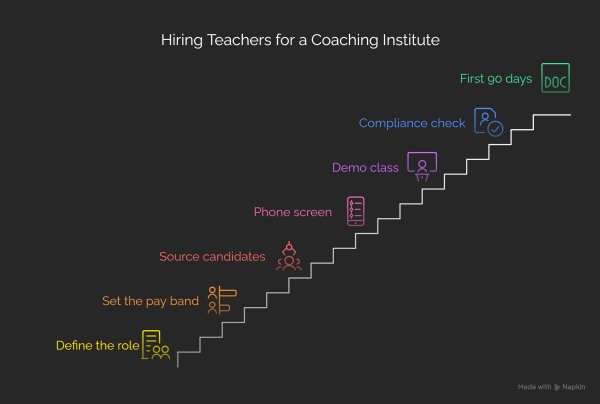
Step 1: Decide what you are hiring for
Good teacher recruitment for coaching institute owners starts with one written role. Most owners instead start with a line like, we need a Maths teacher. That one line hides five decisions. Write all five down before you tell anyone you are hiring. Clear roles also help candidates self-select, so you waste fewer evenings on wrong profiles.
- Subject and level: Class 10 board work and JEE Advanced are different jobs.
- Batch load: Fix the lectures per week and the exact timings.
- Start date: Use the real one, not the hopeful one.
- Pay model: Choose fixed salary, per lecture, or a revenue share.
- Must-haves: Pick two, and treat everything else as nice to have.
Pick your faculty model before you post
Three models run across Indian coaching centres. Each one shifts the risk somewhere else:
Three faculty models, three different risks
Pick the model before you post the role
| Model | Best for | Typical cost | The risk you take |
|---|---|---|---|
| Fixed monthly salary | Core subjects with full batches | ₹25,000 to ₹1,00,000 a month | You pay in full even when a batch stays half empty |
| Per lecture visiting faculty | A subject with one or two batches | ₹500 to ₹5,000 a lecture | They arrive late, or leave mid-session for a better slot |
| Revenue share | A senior name who pulls students in | 20% to 40% of that batch’s fees | Your margin drops, and students follow the teacher out |
Start a thin subject on visiting faculty, then move to salary once two batches fill.
Many owners open a new subject with a visiting teacher. Then they move that person to a salary once two batches fill. This keeps your fixed cost low through the risky first year.
Per lecture pay only works when your lecture log is reliable. Biometric attendance records every session, so pay day never turns into an argument.
Step 2: Set the pay band before the first call
Fix your range before you speak to a single candidate. Owners who skip this step negotiate from a weak spot. Then they either overpay one person or lose three good ones.
Start from the national picture. Indeed India puts the average faculty salary at ₹22,510 a month, updated on 27 February 2026. City gaps are wide in that same data. Mumbai averages about ₹50,000 a month, while Delhi sits near ₹29,090.
Exam-prep coaching pays above that school average. Here is the range we see across institutes we work with:
What to pay, by profile
Four tiers of coaching faculty and what each should deliver
| Profile | Typical monthly pay | What you should get for it |
|---|---|---|
| 1Fresher graduate, Class 6 to 8 | ₹12,000 to ₹22,000 | Energy and discipline, though you train the teaching |
| 22 to 5 years, Class 9 and 10 boards | ₹25,000 to ₹45,000 | Syllabus command and calm parent handling |
| 35 years and above, Class 11 and 12 or entrance | ₹50,000 to ₹1,00,000 | Own notes, own test papers, a result record you can check |
| 4Star faculty with a following | ₹1,00,000 and above, or a revenue share | Students who join because of the name |
From institutes we work with and live job postings in November 2026. Adjust for your city and subject.
These bands come from institutes we work with and from live job postings in November 2026. Treat them as a starting point, then adjust for your city and subject.
Three pay rules that save you money
- Fix the salary date and never move it. A late salary costs you more trust than a small hike buys.
- Put the increment policy in writing on day one. Teachers leave over surprises, not over numbers.
- Keep the results bonus separate from the base. A clean base makes your offer easy to compare.
Pay talks go better with data. Classpro reports show batch results and faculty load, so a review rests on facts instead of memory.
Step 3: Where to find good teachers
Owners often ask us how to find teachers for coaching classes without endless interviews. Most post on one job board and then wait. That brings volume, not quality. So run four channels at once, in this order.
1. Referrals from your current teachers
This is your best source, every single time. Good teachers know other good teachers from college and from their last centre. They also screen for culture before they refer anyone. Offer a referral bonus, and pay it after the new teacher completes 90 days. In our experience, a referral fills a seat in half the time a job board takes.
2. Your own alumni and toppers
Students who did well in your batches already know your syllabus and your pace. Many take a gap year or study in the same city. Start them as doubt-solving assistants for one term. Then move the strong ones to a full batch. Your student performance records show you exactly who topped which batch and when.
3. Job boards and local teacher groups
Indeed, Naukri and WorkIndia give you reach. Local WhatsApp and Telegram groups for teachers in your city often convert better. Write the post with the pay band, the timings and the exact subject. Vague posts pull vague applicants, and you lose a week reading them.
4. Visiting faculty from nearby centres
Plenty of teachers already split their week across two or three places. A clean per-lecture offer with fixed slots can win one of them. Check your state rules before you approach anyone, because some states restrict this. Step 6 covers that.
Your reputation does half the hiring for you. Teachers ask other teachers before they apply anywhere. So the work you put into growing your institute also shortens your next hire.
Step 4: Screen in 15 minutes, not 15 days
One phone call saves you four wasted demo classes. Keep it to 15 minutes, and ask every candidate the same six questions. Score each answer out of 3 as you go.
- Which board or exam have you taught, and across how many batches?
- Take me through how you teach a hard topic to a weak student.
- What do you do when that student still misses it after two tries?
- How do you handle a parent who calls about low marks?
- What timings can you commit to, and what notice period do you serve?
- What monthly pay are you expecting?
Question 2 does most of the work. A strong teacher gives you a concrete sequence with an example. A weak one gives you adjectives.
Listen for these five red flags:
- Cannot name one topic their students usually struggle with
- Blames the last institute for everything that went wrong
- Dodges the pay question twice
- Will not commit to fixed timings
- Has no notes or test papers of their own
Call every shortlisted candidate back within 24 hours. Good teachers accept the first clean offer that reaches them.
Step 5: Run a demo class with a scorecard
Every owner takes a demo class. Very few score it, so the decision comes down to a feeling an hour later. A written scorecard fixes that, and it also settles arguments with your partner or senior teacher.
Demo class scorecard
Score every candidate out of 50, on a live batch
| What you score | What you are watching for | Marks |
|---|---|---|
| 1Concept clarity | Explains the idea in plain words before touching a formula | /10 |
| 2Doubt handling | Takes a wrong answer without making that student feel small | /10 |
| 3Board work and pace | Clean, readable board, and the planned content fits the time | /10 |
| 4Student response | Students look up, answer back, and ask at least one question | /10 |
| 5Exam link | Ties the topic to a real board or entrance question | /10 |
| Total | /50 | |
- 40 and above: Make the offer this week
- 30 to 39: Hire, with one written improvement goal
- Below 30: Say no, however good the CV looks
How to run the demo fairly
- Give the topic 24 hours in advance, never on the spot.
- Use a real batch, not an empty room with two staff watching.
- Keep it to 30 or 40 minutes, the length of your normal lecture.
- Score on your own first, then compare with your senior teacher.
- Ask three students afterwards whether they followed it.
Pay for the demo when it runs on a live batch. ₹500 to ₹1,000 is fair for 40 minutes of real work. Good teachers notice who pays and who does not, and they talk to each other.
Step 6: Check the rules before you make an offer
Coaching hiring is no longer an informal handshake. Several states now regulate coaching centres. Those rules reach into who you hire and what you record. Skip this step and your best hire can turn into a compliance problem.
What the new state rules ask of you
Haryana notified its private coaching institute rules on 24 August 2026. Registration with the District Authority became mandatory, at a fee of ₹10,000. The certificate runs for three years, and renewal costs ₹5,000. The Tribune reported the detail in August 2026.
Three of those requirements land straight on your hiring file:
- You must submit the qualifications and bio-data of every teacher and staff member.
- You must state whether you have completed police verification of your staff.
- You must display tutor qualifications on your website and your notice board.
Rajasthan and Maharashtra have their own coaching laws and drafts in play. Some of these restrict which teachers may take coaching classes at all. So check your own state’s current position before you approach a school teacher or a college lecturer.
Pay and paperwork, by model
- Fixed salary staff: Deduct TDS under Section 192. PF and ESI kick in once you cross the staff and wage thresholds.
- Per lecture faculty: Treat the payment as professional fees under Section 194J.
- Every hire: Issue a written appointment letter covering timings, pay, notice period and your notes.
Ask your chartered accountant to confirm the thresholds for your headcount. These differ by state and by staff count, and the penalty for guessing is yours.
Keep two checks in-house whatever your state says. Run police verification for anyone who teaches minors. Then call the last institute, not just the last manager. Good coaching institute software holds staff records, qualifications and timetables in one place. That makes the annual filing far less painful.
Step 7: Win the first 90 days
Most hiring failures are really onboarding failures. The teacher was fine. Nobody told them how your centre actually runs. Remember that contract roles grew nearly 40% in a year, so your new hire still gets calls. These three months decide whether they pick up.
Week 1: Set them up properly
- Hand over the syllabus plan, the test calendar and last year’s question papers.
- Pair them with a senior teacher as a buddy for the first month.
- Give them logins for homework and share notes on day one.
- Introduce them to their batch parents by message, with their name and subject.
Weeks 2 to 6: Watch and correct early
- Sit in on two lectures, and give one specific piece of feedback each time.
- Compare the first test scores against that batch’s earlier average.
- Ask three students casually how the new sir or ma’am explains things.
- Let parent notifications go out automatically. A new teacher should not chase WhatsApp replies in week two.
Weeks 7 to 12: Confirm or close
- Hold a 30-minute review at week 12, with the demo scorecard in front of you.
- Confirm the role, or end it cleanly while the batch can still recover.
- Write down two goals for the next term, and the date you will review them.
Hiring well is only half the job. Our guide on reducing teacher turnover covers what keeps a good teacher for five years. Stable faculty also lifts student retention, because parents notice who is still teaching in March.
7 mistakes, and what to do instead
Each one feels harmless in the moment and costs you a term
| Mistake | Do this instead |
|---|---|
| ✕Hiring only after someone resigns | ✓Keep a warm list of three teachers per subject |
| ✕Judging the CV instead of the classroom | ✓Score a demo class out of 50, every time |
| ✕Revealing the pay only at offer stage | ✓Put the band in the job post |
| ✕Running the demo in an empty room | ✓Run it on a live batch and ask the students |
| ✕Hiring full time for a thin subject | ✓Start that subject with visiting faculty |
| ✕Promising a hike you have not budgeted | ✓Review pay every six months on a fixed date |
| ✕Leaving the new teacher alone after week one | ✓Follow the 90-day plan in Step 7 |
The first mistake causes the other six. Panic hiring forces you to skip the demo and hope.
The load doubles when you open a second centre. Our branch expansion checklist explains why promoting a teacher you trust beats hiring a stranger.
Your hiring calendar for 2027
Timing decides how much choice you get. Teacher hiring in coaching follows the academic year. So the pool runs deep in some months and empty in others. Work backwards from your batch plan:
Your hiring calendar for 2027
Work backwards from your batch plan
| When | What to do |
|---|---|
| December to January | Map next year’s batches and list the seats you will need |
| February to March | Start sourcing quietly, through referrals first |
| April to May | Run demo classes and make offers, when the pool is deepest |
| June to July | Onboard before the admission rush peaks |
| August to October | Run the 90-day reviews and confirm or close |
| November | Review pay and lock increments before exam season starts |
The worst time to hire is mid-session, when every strong teacher already holds batches.
By then, so you choose from whoever is free. That is how centres end up paying ₹60,000 for a ₹35,000 teacher.
Keep one more habit through the year. Take a coffee with one good teacher a month, even when you have no vacancy. When a seat opens in February, you already know who to call.
Start with one change this season
Good teachers are not scarce. A clear process is. Write the role down and fix the pay band. Score the demo out of 50, then protect the first 90 days. Run that twice and hiring stops feeling like a crisis.
So pick one thing for your next vacancy. Put the pay band in the job post. Then score the next demo class on paper, not in your head.
Want your teachers spending their hours on teaching rather than admin? Start a free trial of Classpro and see the change within a week. You can also compare Classpro plans and pick the one that fits your institute’s size.
FAQs
How do I hire teachers for coaching institute vacancies quickly?
Start with referrals from your current teachers, because that channel moves fastest. Post the role the same day, with the pay band and the exact timings. Then run the demo class within a week. In our experience, a referral-led hire closes in 10 to 15 days.
What qualifications should a coaching institute teacher have?
A degree in the subject is the floor, not the test. For Class 11 and 12 or entrance coaching, look for a record you can verify. Ask for past batch results, their own notes and two student references. A B.Ed helps for school subjects, though coaching rarely demands it.
Should I hire full-time or visiting faculty?
Hire full time when a subject fills two or more batches all year. Use visiting faculty for a new subject or a single batch. Many owners start a subject with visiting faculty, then move that person to a salary. This keeps your fixed cost low through the risky first year.
Can school teachers teach at my coaching centre?
That depends on your state. Some state coaching rules restrict teachers of recognised schools and colleges from taking coaching classes. Haryana also requires you to file every tutor’s qualifications with the District Authority. So check your current state rules before you make any offer.
How do I judge a demo class fairly?
Give the topic 24 hours in advance, and run the class on a live batch. Score it out of 50 across clarity, doubt handling, board work, student response and exam link. Score on your own first, then compare with your senior teacher. Finally, ask three students whether they followed the lecture.