

A parent walks into your centre on a Sunday morning. She picks up your brochure, then two more from the centres down the road. That evening, all three sit on her kitchen table. She reads one of them properly. This post shows you how to write the brochure she actually reads.
Key takeaways
- Parents check fees first, then faculty, then results. Put those three answers on your opening spread.
- Your prospectus is a legal document now. State rules ask for courses, duration and every fee in writing.
- Never print “recognised” or “approved”. Registered centres may use only the word “registered”.
- Always show the denominator. “96 of 140 students cleared NEET” earns more trust than “96 cleared NEET”.
- Nine sections do the whole job. Cover, promise, courses, fees, faculty, results, updates, proof, next step.
What is a coaching brochure, and how is it different from a prospectus?
In short: A coaching brochure is a short document that persuades a parent to visit you. A coaching institute prospectus is the longer official record of courses, fees and rules. Most Indian centres need both. The brochure wins attention, and the prospectus answers every detail.
Many owners use both words for the same booklet. That causes confusion at the counter. A brochure is short, visual and built to persuade. A prospectus is longer, plainer and built to inform. So keep them separate, and give each one a clear job.
The brochure also travels. You hand it out at school gates, demo days and parent meetings. The prospectus stays at your centre and goes home with admitted families. It also goes to the district authority when you apply to register. Our guide to coaching institute registration covers that paperwork in detail.
| Document | Length | Main job | Who reads it | When you hand it over |
|---|---|---|---|---|
| Brochure | 2 to 4 pages | Persuade | Parents shortlisting centres | Enquiry, demo day, school gate |
| Prospectus | 8 to 24 pages | Inform and record | Admitted parents, regulators | Admission and registration |
| Pamphlet | 1 page | Announce one thing | Anyone passing by | Batch launch, scholarship test |
What parents look for in the first 30 seconds
In short: Parents scan for fees, batch size, faculty, results, timings and distance. Then they decide whether to read on. So answer all six on page one.
Coaching is a real household expense today. India’s Comprehensive Modular Survey on Education, 2025 covered 52,085 households. It found that 27% of students take private coaching. Urban families spend ₹3,988 a year per student on coaching, while rural families spend ₹1,793.
That money comes from the family in almost every case. So a parent reads your fee page like a bill, not like an advertisement. She is also comparing you against two or three other centres that week.
Most parents never say any of this out loud. However, six questions sit in her head while she reads:
- What will this cost me in total? Not just the first instalment.
- How many students sit in one batch? Small batches signal attention.
- Who actually teaches my child? Names, not job titles.
- What results did last year’s batch get? With the full numbers.
- What are the class timings? They must fit school hours.
- How far is the centre? Travel time decides many admissions.
The 9 sections every coaching brochure needs
In short: Nine sections cover everything a parent needs. Start with the cover and your promise. Then give courses, fees, faculty and results. Finish with updates, proof and one clear next step.
1. A cover that names the exam, the class and the locality
Your cover has one job. It tells a parent that this brochure is for her child. So name the exam or board, the classes you teach, and your locality. For example: “NEET and JEE coaching for Classes 11 and 12, Anna Nagar.”
Skip the stock photo of a smiling foreign student. Use a real photo of your classroom instead. Parents recognise the difference at a glance.
2. One promise you can keep
Write a single line that says what you do better than the centre next door. Keep it specific and keep it true. “Batches of 20, so every doubt gets answered” beats “excellence in education.”
Pick a promise your daily routine already delivers. Then every teacher can repeat it in a counselling call. Our post on coaching institute branding explains how to build that line.
3. Courses, batches and hours in a table
Parents compare centres on a table, so give them one. List each course, the classes it serves, the batch size, the weekly hours and the duration. A table also helps when you apply to register your centre.
Add the start date for every batch. Many parents enquire late and worry about missed classes. A clear date removes that doubt.
4. Fees, instalments and the refund policy
Hiding fees costs you admissions. A parent who cannot find the fee assumes it is high. So print the total fee, the instalment plan and the due dates.
Add your refund policy in plain words. Say what happens if a student leaves in the first month. Then record every payment in one place, because disputes start with missing receipts. A fee management system handles that for you. For blended batches, read our guide to the fee structure for hybrid coaching classes.
5. Faculty names with real qualifications
“Experienced IIT faculty” means nothing to a parent. A name and a degree mean a lot. So list each teacher, the subject, the qualification and the years of teaching.
Add one line about what each teacher does well. For example: “Takes the Sunday doubt session for Organic Chemistry.” That detail makes the person real.
6. Results with the full denominator
This is where most brochures lose trust. “96 students cleared NEET” raises an obvious question. Out of how many? Print both numbers, every time.
Honest numbers age well. A parent who joins on a true claim stays for three years. A parent who joins on an inflated one leaves by the second term. Also, a student performance report gives you clean figures to publish, with parent consent.
7. How you keep parents updated
Parents fear losing track once the fee is paid. So tell them exactly how you report progress. Name the frequency, the format and the channel.
For example: “Monthly test report on WhatsApp, plus a parent meeting each term.” Then deliver it. Notifications and reminders handle the routine updates. Also, a student and parent app keeps marks and attendance in one place.
8. Proof a parent can check
Claims persuade, but proof converts. Add two or three short parent quotes with first names and class. Add your Google rating if it is good.
A QR code works well here. Point it at your results page or your Google reviews. Many parents scan it while they sit in your office. Then invite them to a demo class, because one free session beats any paragraph.
9. One clear next step
End with a single action, not four. Pick the one you can serve fastest. “Call this number to book a free demo on Saturday” works better than a list of options.
Print one number, one WhatsApp link and your address with a landmark. Then answer every enquiry the same day. Next, track every brochure lead in an enquiry and lead management system. Then none of them goes cold.
What the coaching rules say your prospectus must carry
In short: A prospectus is now part of your registration file. States ask for curricula, duration and all fees. They also ban the words “recognised” and “approved” on it. You may print only “registered coaching institute”.
The Ministry of Education’s guidelines for regulating coaching centres started this shift. States then wrote their own rules. Haryana notified its rules in August 2026. Every private coaching institute there must now register with its district authority.
That application has to carry a copy of the prospectus. The copy must detail the different curricula and the duration for completing them. It must also show details of all types of fees. Meanwhile, the same rules allow the phrase “registered coaching institute” on a signboard or prospectus. However, they do not allow “recognised” or “approved”.
So two things follow for you. First, write the prospectus before you apply, not after. Second, check your old brochure for banned words today. Rules differ by state, so read your own state notification as well.
Print or digital: Which coaching brochure works harder now?
In short: Print still wins at the counter and the school gate. Digital wins for reach and updates. Most centres do best with one short printed page and a longer PDF behind a QR code.
The market is growing, so your brochure competes with more centres each year. IMARC values the India coaching institutes market at USD 8.1 billion in 2026. That figure is up from USD 7.2 billion in 2025. As a result, a parent now compares more documents than before.
| Format | Strength | Weakness | Best use |
|---|---|---|---|
| Printed brochure | Stays on the table at home | Costs money to reprint | Demo days, school gates, counter |
| PDF prospectus | Easy to update and send | Rarely read on a phone | WhatsApp follow-up, website |
| One-page pamphlet | Cheap and fast | Too thin to persuade | Scholarship tests, batch launches |
Print a short brochure and keep the detail digital. Then you never reprint 2,000 copies for one fee change. Put the QR code on the front, where a parent sees it first.
Order your print run in small batches too. Fees change, teachers move, and new results arrive each summer. A pile of old stock tempts you to hand out wrong information. Therefore, print for one admission season at a time.
7 mistakes that make parents put your brochure down
In short: Most brochures fail on the same seven points. They hide the fee, inflate results or use stock photos. Others skip teacher names, break the rules, or forget the next step.
- Hiding the fee: Parents assume the worst and move to the next centre.
- Results without the denominator: One sharp question at the counter destroys the claim.
- Stock photos of foreign students: Your real classroom photo builds more trust.
- Faculty without names: “Expert faculty” tells a parent nothing at all.
- Long paragraphs: Nobody reads a wall of text at a school gate.
- Banned words: “Approved” and “recognised” can put your registration at risk.
- No next step: An interested parent closes the brochure and forgets you.
In our experience, the fee mistake costs the most admissions. Fix that one first. Then work down the list in order.
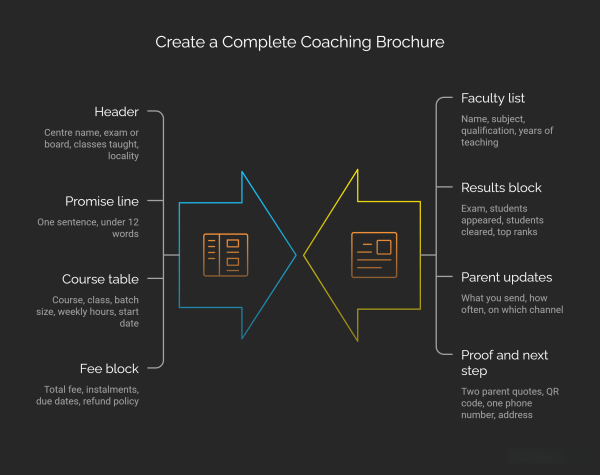
A two-page coaching brochure format you can copy
In short: Two sides of one A4 sheet hold everything. Use the front for your promise, courses and fees. Use the back for faculty, results, updates and the next step.
Front side, top to bottom:
- Header: Centre name, exam or board, classes, locality.
- Promise line: One sentence, under 12 words.
- Course table: Course, class, batch size, weekly hours, start date.
- Fee block: Total fee, instalments, due dates, refund policy.
Back side, top to bottom:
- Faculty list: Name, subject, qualification, years of teaching.
- Results block: Exam, students appeared, students cleared, top ranks.
- Parent updates: What you send, how often, on which channel.
- Proof and next step: Two quotes, a QR code, one number, one address.
Keep the font large. Many parents read without their spectacles at a counter. Leave white space between blocks, so the page never looks heavy.
How to get your brochure into the right hands
In short: A brochure works only where parents already stand. Use demo days, parent meetings, school gates and enquiry follow-ups. Then track which source brings admissions.
Hand it over in person wherever you can. Give one to every parent who attends a demo class. Give one at each parent teacher meeting, because happy parents pass it to neighbours. That beats any letterbox drop.
Then send the PDF after every enquiry call. Follow up within a day while interest is high. Finally, check which source actually converts. A simple reports dashboard shows you whether demo days or school gates bring more admissions.
Conclusion
A good coaching brochure is not a design job. It is an honesty job. Print your fees, name your teachers, show the full result numbers, and give one clear next step.
Start with the two-page format above this week. Then track every enquiry it brings. Start your free Classpro trial to follow up on each one, or see Classpro plans and pricing.
FAQs
What should a coaching brochure include?
A good brochure for coaching classes includes nine things. Cover, promise, course table, fees, faculty, results, parent updates, proof and one next step. Keep fees and results honest, because parents verify both.
What is the difference between a brochure and a prospectus?
A brochure persuades a parent to visit you, and runs 2 to 4 pages. A coaching institute prospectus records courses, duration, fees and rules in full. Your prospectus also goes with your registration application.
How many pages should a coaching class brochure have?
Two pages work for most centres. One A4 sheet, printed on both sides, holds every answer a parent needs. Keep longer detail in a PDF behind a QR code.
Can I write “approved by the government” in my prospectus?
No. State rules allow only the phrase “registered coaching institute” on a signboard or prospectus. They do not permit words like “recognised” or “approved”.
How much does it cost to print a brochure in India?
Costs vary by city, paper and quantity. Get quotes from two local printers before you order. In our experience, printing 500 short brochures costs far less than reprinting after a fee change.
When should I update my brochure?
Update it once a year, after your results arrive. Also reprint whenever your fees, batches or teachers change. An old fee on a current brochure starts arguments you do not need.